
Papua is not only rich in forests and culture, but is also home to one of the world’s most iconic birds: the bird of paradise. Of the 43 species of birds of paradise, 38 can be found in eastern Indonesia. This bird is famous for its beautiful and striking plumage, so much so that it has been dubbed the “bird of paradise.” Among its many species, one stands out in particular, the Great Yellow Bird of Paradise (Paradisaea apoda).
Morphology: The Appearance That Makes It Iconic
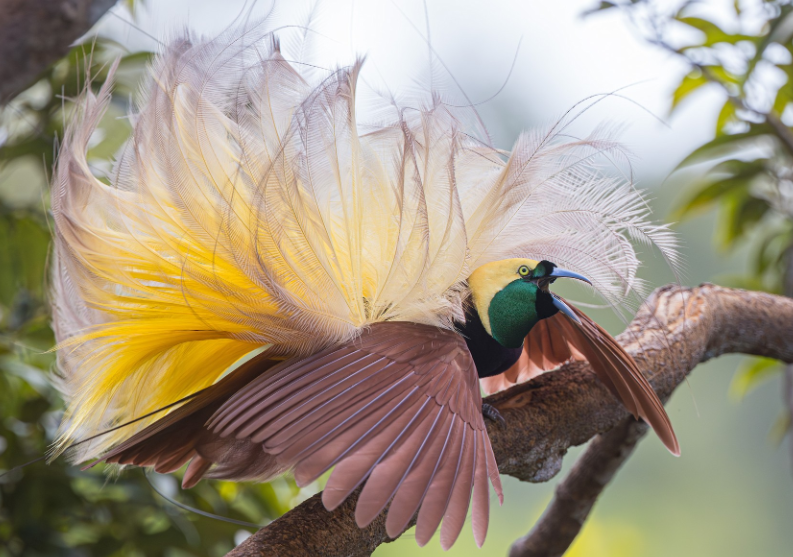
The Great Yellow Bird-of-Paradise has very striking characteristics, especially in the male. It can reach a length of 43 cm, not including a pair of long tail feathers that trail like golden ribbons through the air. Its head is adorned with a yellow crown, an emerald-green throat, a dark-brown chest, and golden-yellow decorative feathers. In contrast, the female has a much simpler appearance. Her body is smaller, about 35 cm, with plain maroon plumage and no striking adornments. Yet this simpler appearance makes the male’s colorful feathers stand out even more. The male’s extraordinary plumage serves as his primary tool for attracting the female’s attention.
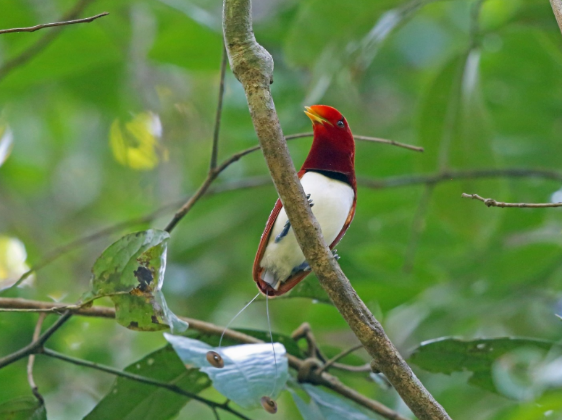
The King Bird of Paradise (©Nigel V)
By comparison, the king bird of paradise (Cicinnurus regius) is much smaller, measuring only about 16 cm. Even though it is small, it remains one of the most eye-catching birds-of-paradise. The male is bright red with a white breast, an emerald-green throat, striking blue legs, and a unique spiral tail. Combined with the fan-like feathers on its shoulders, this tiny bird looks like a living gem when it dances.
Behavior: Exotic Mating Dances
The mating behavior of the great yellow-billed bird-of-paradise is one of the most captivating natural spectacles in the forests of Papua. Male birds perform a distinctive dance on high branches, displaying their flowing golden-yellow plumage and singing their characteristic song. Interestingly, before the performance begins, the male cleans the branch he is perched on so that his body stands out more clearly against it. This spectacle takes place in an arena called a lek, where several males gather and compete to put on their best display in order to attract the attention of females.
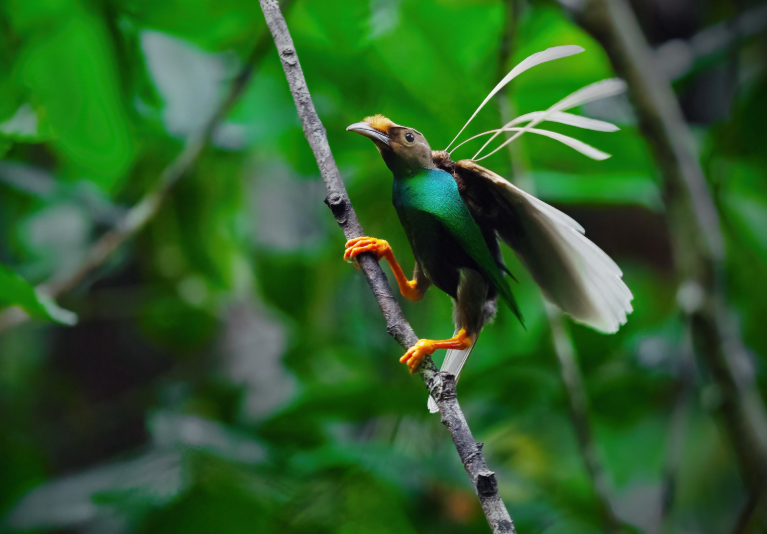
Standardwing Bird of Paradise (©JJ Harrison)
It turns out that each species of bird-of-paradise has its own unique courtship dance. While the Great Yellow Bird-of-Paradise dances in the canopy of tall trees, the Standardwing Bird of Paradise (Semioptera wallacii) from Halmahera does things differently. This species has a distinctive courtship display in which it fans out its shoulder feathers like a fan while hopping along the lower branches of the forest. This variation in dance demonstrates the rich diversity of courtship behaviors within the bird-of-paradise family, while also underscoring its role as a symbol of Papua’s magnificent biodiversity..
Limited Distribution
The Great Yellow Bird of Paradise (Paradisaea apoda) actually has a fairly limited range compared to some other species of birds-of-paradise. This bird of paradise can only be found in the lowland forests of southern and southwestern Papua, extending to the central highlands of Papua New Guinea. Interestingly, they also inhabit Aru Island in Southeast Maluku, making them one of the truly distinctive endemic species in eastern Indonesia.
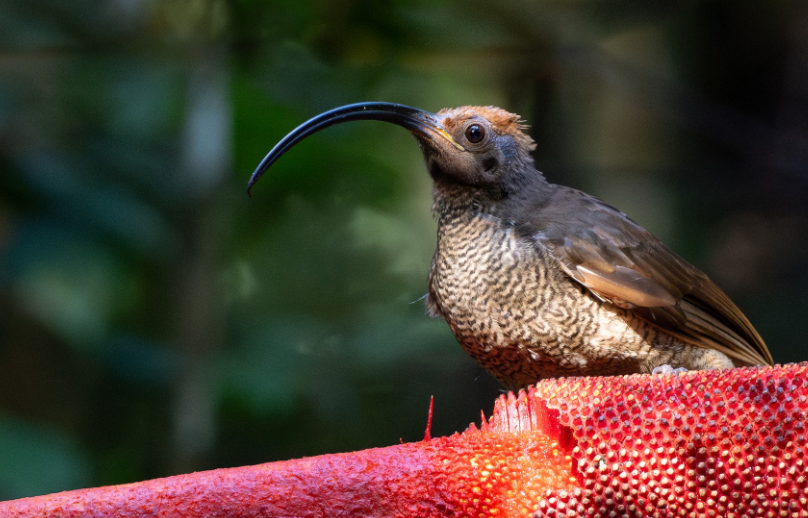
Black sicklebill (©Phil Chaon)
Each species of bird of paradise has a unique distribution pattern. Some are able to adapt to many regions, while others are restricted to a single island. For example, the king bird of paradise (Cicinnurus regius) has a fairly wide distribution in the southern and western parts of Papua, extending to the Aru Islands. This species is also relatively flexible, as it can be found in both lowland forests and secondary forests.
In contrast, the Standardwing Bird of Paradise (Semioptera wallacii) is an example of extreme endemism. This bird is found only on Halmahera Island in North Maluku, making its presence truly unique to that region. There is also the Black sicklebill (Drepanornis sp.), which inhabits the central mountainous region of Papua. This species has specialized adaptations to the cooler, more humid montane environment.
These differences in distribution patterns demonstrate just how diverse the ways are in which each species adapts to its habitat. From lowlands to mountains to small islands, birds of paradise truly reflect the ecological richness and evolutionary history of Papua and eastern Indonesia.
