
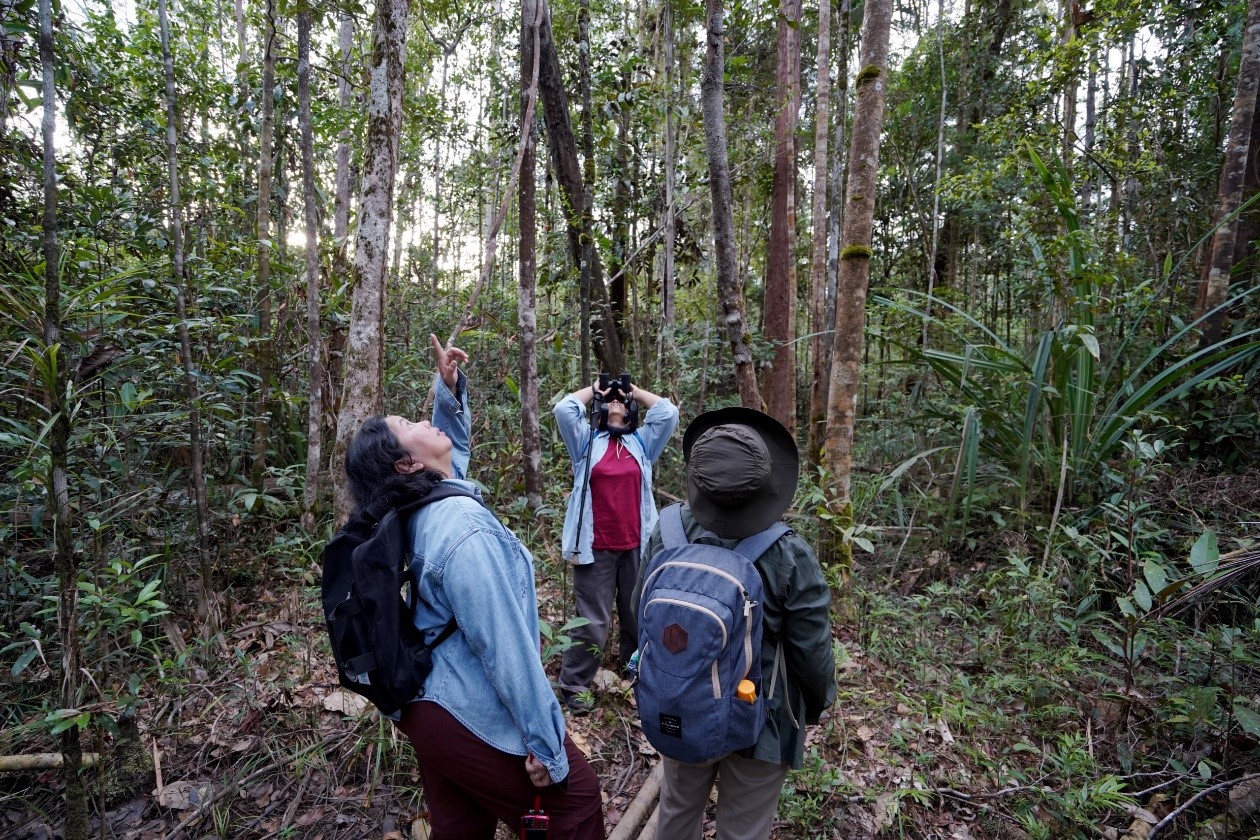
Photo: IPB University team doing biodiversity monitoring at a conservation area near TSE Group’s operational site in South Papua. This activity supports endemic fauna protection efforts in the region
MERAUKE – Papua Conservation, the biodiversity project by IPB University and Tunas Sawa Erma (TSE) Group, enters a new chapter. Recently, it reached its fifth year of research in the conservation area around TSE Group’s operational site in South Papua.
This area includes High Conservation Value (HCV) and High Carbon Stock (HCS) forests previously identified by the company. Such places are home to the local endemic wildlife — particularly the greater birds-of-paradise (Paradisaea apoda) and pig-nosed turtles (Carettochelys insculpta).
“We believe effective conservation is supported by scientific research and data. Through [our] collaboration with IPB University, we hope to enrich public understanding of the ecological diversity in Papua, while improving the systems that manage conservation areas around our site,” said Luwy Leunufna, TSE Group’s director on Friday (7/8/2026).
Papua Conservation partly focuses on the greater birds-of-paradise, with observational activities centered around a critical period in the annual migration cycle. It’s this period when birds of various species travel to warmer regions, readying themselves before the breeding season.
With this in mind, the project later conducted a 40-day study on lekking, a behavior in which male birds-of-paradise dance to attract female counterparts.
Another focus of Papua Conservation is the pig-nosed turtles. Following a previous examination of this High Conservation Value species, Prof. Ani Mardiastuti, Dr. Yeni Aryati Mulyani, and six other members of the research team will track their reproductive behavior.
Monitoring enclosures will be installed around the habitat as the team undergoes each stage of the intensive observation period (mating, egg-laying, and hatching). This activity is scheduled to be completed after approximately 90 days to enable comprehensive data collection.
The research team will also interview local community members and deploy Global Positioning System (GPS) devices in their study of the turtles’ movement patterns and activity in the water. They hope to gain insight into the turtles’ home range, habitat preferences, and daily routine.
Papua Conservation’s fifth anniversary demonstrates that academia-private sector partnerships can contribute to biodiversity conservation and viability in Papua. This ongoing project is expected to provide stronger data to reinforce conservation area management and wildlife protection initiatives. (PR)
