
The Great Yellow Bird-of-Paradise (Paradisaea apoda) truly deserves to be called the star of the Papuan rainforest. Its shimmering golden plumage and graceful courtship dance always never fails to capture attentions. But beauty alone does not guarantee survival in the wild. We also need to know how many of them are left. We can only find that answer through field research. Every time researchers record an encounter with these birds of paradise, we are one step closer to understanding the best way to keep them dancing in the forests of Papua.
Tracking in Forests and Rivers
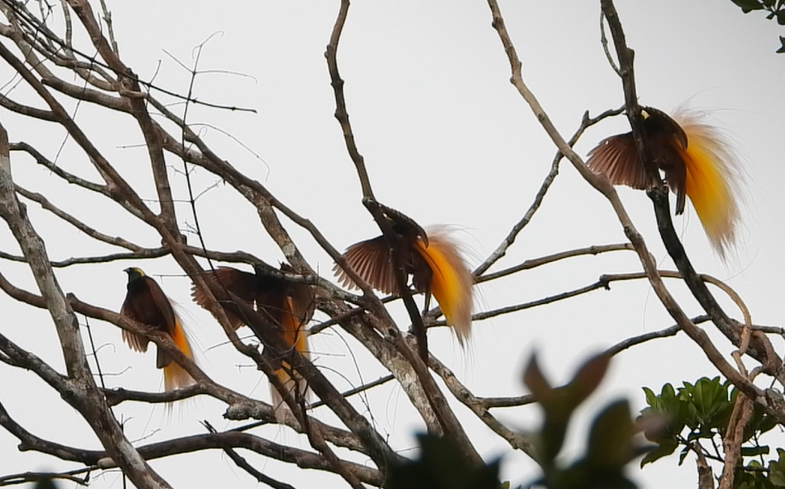
In a joint study conducted by the TSE Group and IPB University, a research team explored the forests of Papua all the way to the riverbanks in search of the Great Yellow Bird of Paradise. The results were quite interesting: out of 39 spotting locations, 56 of these birds of paradise were recorded—11 males and 45 females. They appear to thrive in a variety of habitats, ranging from primary and secondary forests to bushes.
What’s even more interesting is that the numbers vary from each region. Thirty-seven birds were found in the PT Inocin Abadi concession, compared to just 15 in the PT Tunas Timber Lestari concession. In fact, four birds were still spotted along the banks of the Kao and Muyu Rivers, indicating that rivers are not merely waterways but also vital corridors for the survival of birds of paradise.
A Voice Heard, A Hidden Figure
Interestingly, not all encounters involved direct sightings. At some locations, researchers only heard the distinctive call of the Great Yellow Bird of Paradise without actually seeing the bird itself. This demonstrates just how skillfully this bird hides within the dense forest canopy. Even so, the loud calls of the males, calling to females from their perches, serve as a strong indication of their presence.
Activity times were also an important finding. The Great Yellow Bird of Paradise is active from around 7:00 a.m. until 5:00 p.m., with peak activity occurring from midday through the afternoon. This pattern helps researchers determine the best times to conduct observations.
An Unbalanced Male to Female Ratio
One particularly striking finding concerns the ratio of males to females. In the first study, the ratio was found to be skewed—only 1 male for every 4.1 females. There are many possible causes. It could be that the male population is naturally smaller. However, there is also strong evidence that poaching targeting males with beautiful plumage has contributed to their decline in the wild.
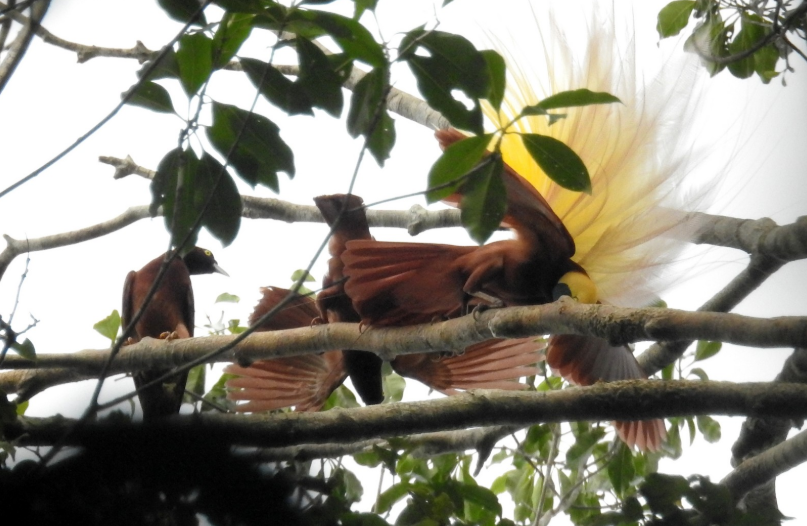
Interestingly, the results of the study the following year were quite different. Because it was conducted during the breeding season, a greater number of males were observed—60 males and 40 females (a ratio of 1:0.6). This makes perfect sense, since during the breeding season males typically put on a spectacular display in lek trees to attract females. This finding serves as an important reminder that the timing of a study can significantly influence the picture of the population in the field.
 Living in Small Groups
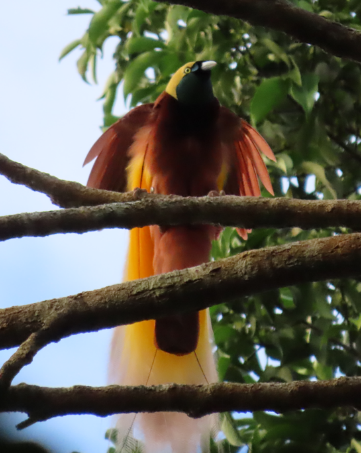
Field observations also provide an interesting insight into the lifestyle of the great yellow bird-of-paradise. Female birds are usually seen flying in small groups of 3–5. In contrast, males are more often seen alone. This pattern aligns with their lek behavior—the males are busy guarding their respective “stages” on the lek trees, while the females arrive in groups, much like an audience gathering to witness a remarkable performance.
From Data to Action: Preserving the Timeless Dance of the Great Yellow Bird of Paradise
Tracking the number and distribution of birds of paradise isn’t just about the numbers. This data serves as a vital guide for determining what needs to be done to save them. If the number of males is declining, we know there’s cause for alarm. If there are areas with high sighting rates, that means those areas should be prioritized for stricter protection.
Research findings on the great yellow bird of paradise clearly show that they still exist, but the challenges are real. A skewed sex ratio, poaching, and habitat pressure pose serious threats. The good news is that data like this provides a foundation for meaningful conservation action. By working together with local communities, protecting their habitats, and creating sustainable opportunities through ecotourism, we can help ensure that these remarkable birds continue to thrive in Papua’s forests. Their survival is not only important for biodiversity, but also for preserving one of Indonesia’s most iconic natural treasures.
