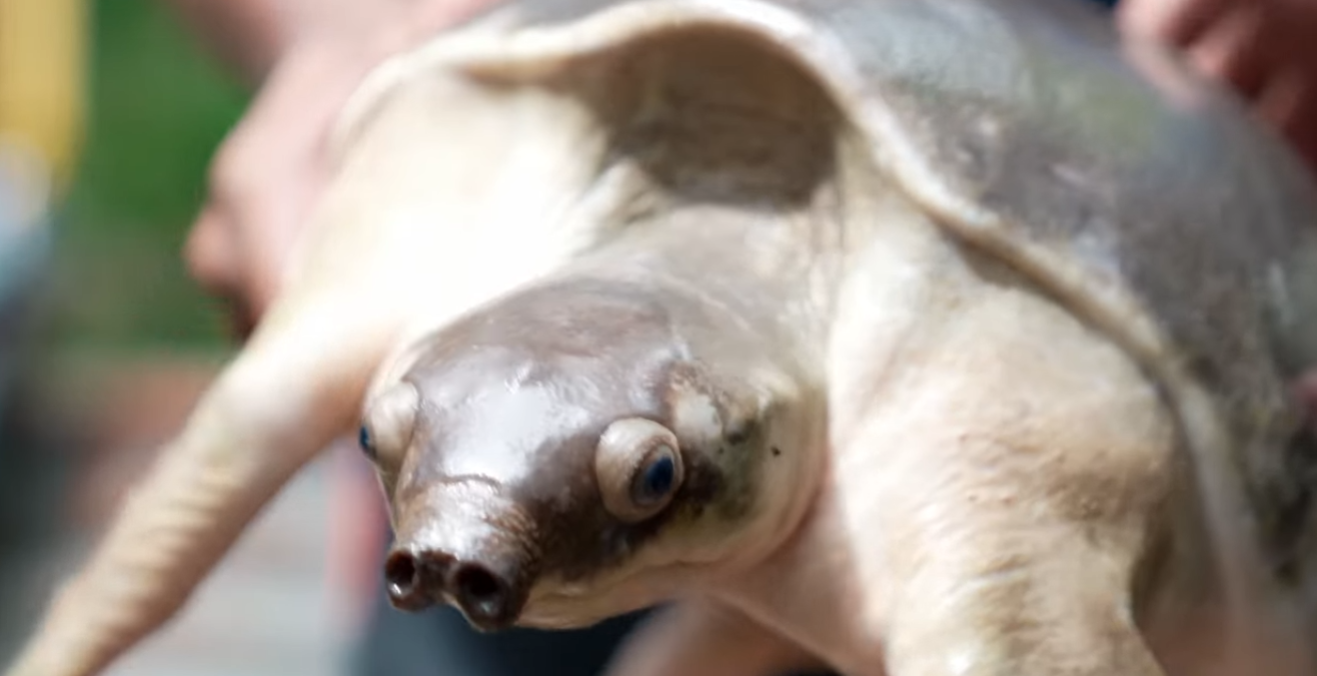
Photo: The pig-nosed turtle and bird-of-paradise are endemic to the Kali Kao region. TSE Group highlights the urgency of preserving their natural habitat through a video documentary.
BOVEN DIGOEL – Amidst Papua’s lush forests and pristine rivers, rare species coexist with nature. Some have yet to receive scientific names, waiting to be studied further by researchers.
In Papua’s waters, one notable species is the pig-nosed turtle (Carettochelys insculpta), a unique reptile believed to have survived for over 100 million years. Meanwhile, up in the tropical forest canopy, the greater bird-of-paradise (Paradisaea apoda) dances with its distinctive golden feathers, serving as a symbol of Papua’s natural beauty.
Both species inhabit the Kali Kao region, a river that is integral to the forest ecosystem and a life source for local communities. For many residents, Kali Kao is more than just a waterway; it is the lifeblood connecting humans, forests, and wildlife that have coexisted for generations.
Through a documentary video, Tunas Sawa Erma (TSE) Group highlights the importance of protecting the habitats of Papua’s endemic wildlife, given their high ecological value. The video portrays Kali Kao as a home to various species, including the river-dwelling pig-nosed turtles and the canopy-inhabiting greater birds-of-paradise.
This documentation also aims to raise public awareness regarding endemic wildlife conservation and the importance of maintaining ecosystem balance in Papua.
The video on Kali Kao is available in three languages to reach a wider audience:
Through this documentary, TSE Group hopes to encourage more people to recognize and care for Papua’s rich biodiversity and understand the importance of preserving natural habitats for future generations. (PR)
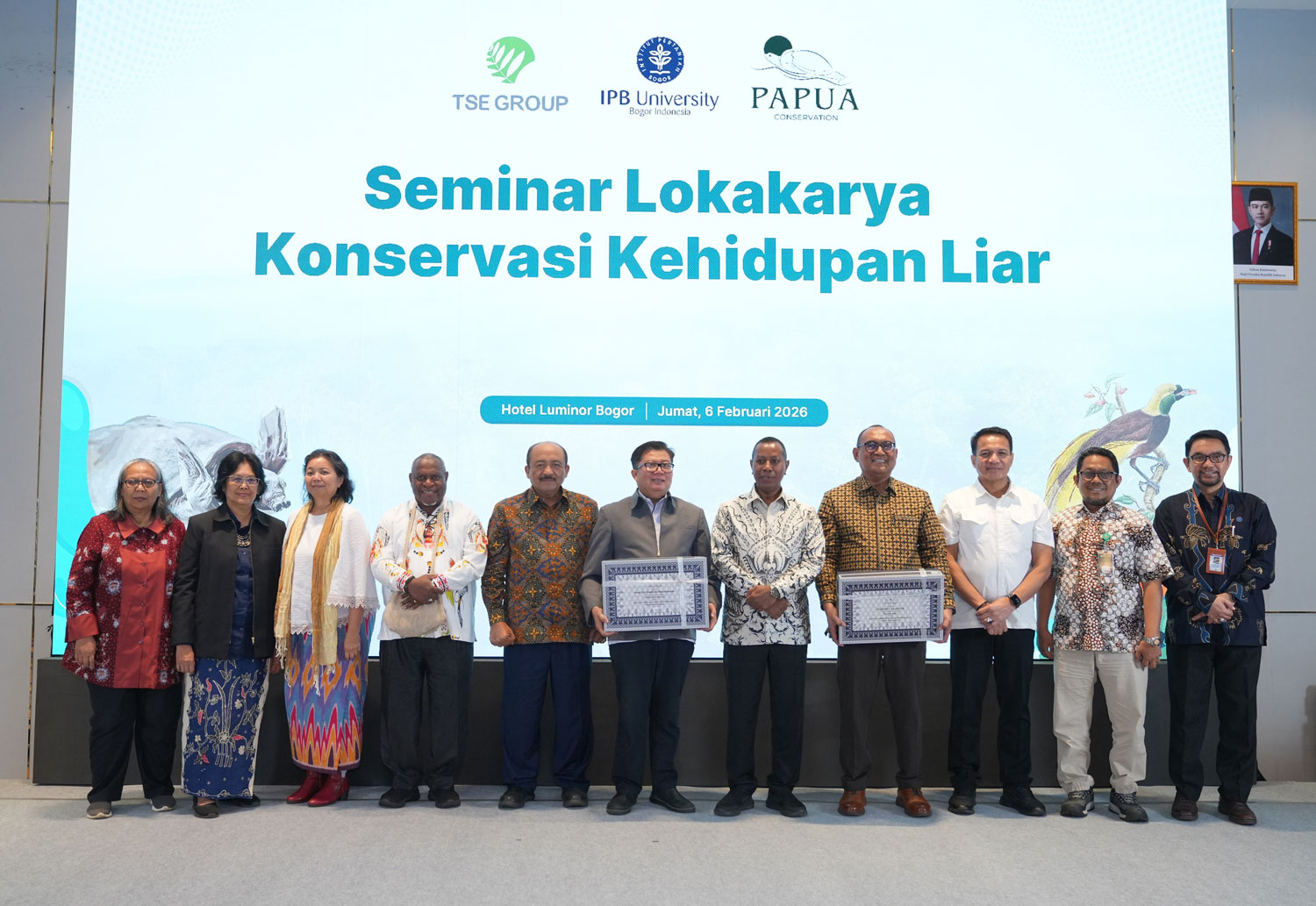
This event is attended by IPB University’s bird-of-paradise and pig-nosed turtle research teams, South Papuan Governor Apolo Safanpo, South Papua’s Papua’s People Assembly Chairman Damianus Katayu, National Research and Innovation Agency (BRIN) officials, management authorities, academicians, and Indonesian Palm Oil Association members
BOGOR — Despite climate changes, the responsible management of production forests and riverscapes continues to help protect pig-nosed turtle and greater bird-of-paradise homes in Papua, said a four-year joint research between IPB University and Tunas Sawa Erma (TSE) Group.
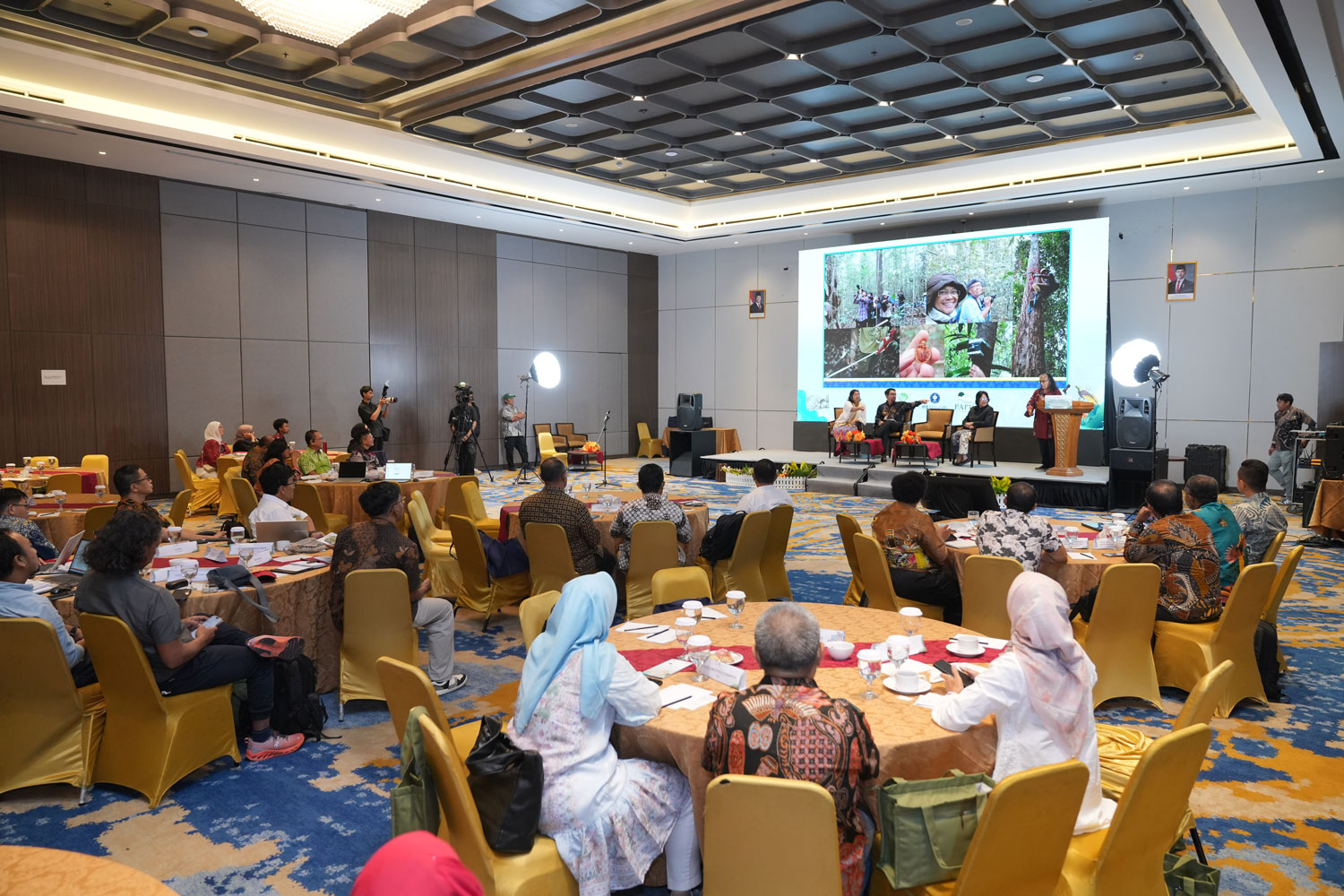
This finding was made public at “Melindungi Ikon Papua: Pemantauan Jangka Panjang Kura-kura Moncong Babi dan Cenderawasih” (Preserving Papua’s Icons: Long-Term Observation of Pig-Nosed Turtles and Birds-of-Paradise), a wildlife conservation seminar and workshop held Friday (2/6/2026) in Bogor. The event was part of a long research project conducted by IPB University and TSE Group since 2022.
Another point highlighted consistent occurrences of greater birds-of-paradise (Paradisaea apoda) within TSE Group’s production forests, where selective harvesting is practiced. Throughout the study, over 100 birds were identified across two forest concessions, with half of the area showing high levels of habitat suitability.
Authors have also found success in documenting lekking (mating) events, and recognizing lek and food-producing trees that are key to the species’ longevity.
Prof. Ani Mardiastuti — in charge of the greater birds-of-paradise research — said forest management practices that maintain high conservation value (HCV) areas and employ selective harvesting contribute to endemic bird preservation in Papua.
“Responsibly-managed production forests remain capable of supporting the lives of birds-of-paradise, and even hold potential for birding ecotourism.”
Meanwhile, on the freshwater front, a close examination of the pig-nosed turtles revealed climate change as an increasingly defining factor for the species’ breeding success.
Extreme precipitation and flooding on the Kao River have caused spawning failure in multiple observation sessions, underscoring the need for conservation strategies that rely both on habitat safeguarding and climate adaptation.
Pig-nosed turtle researcher, Prof. Mirza D. Kusrini, emphasized the importance of long-term monitoring in studying the effects of weather anomalies on animal life cycles.
Prof. Mirza D. Kusrini, Prof. Ani Mardiastuti, and Dr. Yeni A. Mulyani speaking on pig-nosed turtle, greater bird-of-paradise, and herpetofauna research conducted by IPB University’s Forestry and Environment Faculty and TSE Group
“Prolonged observations are crucial for understanding weather anomaly impacts on breeding success. By working with locals, we can ensure conservation efforts continue unabated.”
From a business perspective, this research establishes stronger foundations for accountable forest management practices. TSE Group’s Director Wicklief F. Leunufna affirmed local environmental and wildlife preservation as part of the company’s commitments.
“Through our research collaboration with IPB University, we aim to continuously align our operations with evidence-based conservation.”
This seminar slash workshop featured a cross-sectoral discussion forum that identified opportunities and obstacles to long-term observation. The segment also suggested science-based policy and technical recommendations for protected wildlife management in Papua.
IPB University’s Forestry and Environment Faculty Dean, Prof. Dodik Ridho Nurrochmat, hoped to see their study being referenced in future regional policymaking.
The seminar is part of IPB University and TSE Group’s accountability reporting in regard to this long research project
“We hope this forum becomes a platform for knowledge exchange, as well as stakeholder input and mandate to keep our research aligned with needs for actionable policies.”
South Papuan Governor Apolo Safanpo, also in attendance, said data-driven research is central to public policy decisions. Credible studies ensure development decisions and natural resource management are carried out with respect to the people and planet, he added.
Altogether, IPB University and TSE Group’s joint project covers wildlife population monitoring, HCV area protection, and technical recommendation development for managing key species. Its results are expected to serve as a valuable reference for local governments, businesses, and other stakeholders in strengthening wildlife and broader ecosystem conservation in Papua, especially in the face of climate change pressures. (*)
National palm oil company Tunas Sawa Erma (TSE) Group is building a research vessel called Papua Lestari. Photo: TSE doc.
Papua: Indonesia palm oil company Tunas Sawa Erma (TSE) Group is building a research vessel called “Papua Lestari” to find out about the life of the pig-nosed turtle and the river ecosystem of its habitat in South Papua.
The vessel can accommodate five people to do activities inside. The vessel not only provides space for research equipment but also equips researchers with various facilities to simplify their work.
This vessel is an important facility to conduct research on aquatic biota in Papua, especially the pig-nosed turtle. We hope that “Papua Lestari” will enhance the quality of research by enabling researchers to carry out their activities more effectively.
The research vessel “Papua Lestari” is actually a facility provided by the TSE Group, not only as a means of transportation for researchers but also as a symbol to spread the message of conservation.
Environmental conservation
“We built Papua Lestari to research the ecosystem in rivers and swamps in Papua, including pig-nosed turtles, fish, snakes, and so on.” In addition, this research vessel can also be a symbol to open people’s eyes to the importance of environmental conservation,” said TSE Group Director Luwy Leunufna in a written statement, Tuesday, April 29, 2025.
The completion of this ship is part of the Papua Conservation Program commitment launched by TSE Group and IPB University in 2022. This programme aims to protect the right to life and increase public awareness of endemic animals.
This programme not only focuses on conservation for pig-nosed turtles but also other endemic Papuan animals, namely the large yellow bird of paradise in Merauke and Boven Digoel Regencies, South Papua.
TEMPO.CO, Jakarta – Security officers of Mozes Kilangin Airport Timika, Papua have thwarted an attempt to smuggle thousands of pig-nosed turtles to Jakarta by Sriwijaya Air flight, Thursday, March 24, 2016.
Conservation Division Chief of Region II Timika Yohan Frans Mansay said that the number of pig-nosed turtles attempted to be smuggled was 1,220.
The turtles were packed in two cardboard boxes. “A person, with the initial “S”, carried an item to Timika Airport terminal. During the examination in x-ray machine, officers had suspicions about the item before [eventually] seizing it. The officers called the quarantine agency. Upon checking the cardboard boxes, they found thousands of protected pig-nosed turtles in it,” Yohan said.
He said the turtles were taken to Timika Airport Police Sector before being handed over to Timika natural conservation agency (KSDA) to be secured in tailing reclamation area of PT Freeport Indonesia in Maurupauw, MP 21.
“S” works as ground handling officer of Sriwijaya Air at Mozes Kilangin Airport Timika. Yohan could not confirm on who the owner of hundreds of pig-nosed turtles was. “We have reported it to Papua’s Head of BKSDA [conservation center]. We will wait for the arrival of civil service investigators to investigate the case,” he said.
“We call for support from all parties to help us in preventing pig-nosed turtles smuggling from Papua because it’s a protected species,” Yohan said.
In February, Timika Airport authorities had also thwarted smuggling attempt of 3,220 pig-nosed turtles from Timika to Jakarta which was packed in four luggages.
Pig-nosed turtle is a protected species endemic to Papua. The endangered species live only in southern districts of Papua, such as Mappi, Asmat and Mimika.
15 pignosed turtles were secured when they were about to be smuggled into Kalimantan using MT, Saturday (24/2). (ANTARA/HO/South Papua Quarantine Doc)
JAKARTA – South Papua’s quarantine thwarted the smuggling of a pig-snouting tortoise that was about to be sent through Merauke Harbor.
“It is true that quarantine officers have thwarted the smuggling of pig-nosed turtles that will be smuggled using the MT Motorboat bound for Kalimantan on Saturday (February 24),” said South Papua Quarantine Head Cahyono when contacted in Jayapura, Sunday, February 25 evening, confiscated by Antara.
It was recorded that 15 pig-nosed turtles were put in buckets which were placed on the shoe racks, then covered with cloth.
In his written statement, Cahyono regretted that there were still irresponsible people who brought protected endemic animals.
“We must maintain natural resources in Papua, both flora and fauna so that they remain sustainable, because if they do not, they can accelerate their extinction and disrupt their natural habitat ecosystem,” he said.
“The quarantine will do its best to prevent the smuggling of native animals and plants in Papua,” said Cahyono.
Head of the South Papua Quarantine Law Enforcement Team, Suwarna Duwipa, added that the smuggling of 15 pig-nosed turtles and a dilute bird was thwarted through surveillance at the port.
The supervision was carried out on ships that were about to leave Merauke Harbor to prevent smuggling, especially protected animals and plants in accordance with Article 72 of Law Number 21 of 2019 concerning Animal, Fish, and Tumbuhan Quarantine.
Quarantine has the task of monitoring and controlling wild plants and animals, as well as rare plants and animals.
Moreover, the pig-nosed tortoise is an endemic animal in the southern region of Papua that is protected because its presence in nature is small.
“According to the International Union Conservation Nature (IUCN), the pig-snouting tortoise has a vulnerable status, and is included in the redlist of Appendix II by the International Convention Trade in Endangerd Species of Wild Flora and Fauna (CITES),” said Duwipa.
The pig-nosed tortoise will be handed over to the Natural Resources Conservation Center (BKSDA) of the Merauke area as the agency authorized to carry out further processes.
A visitor to the Singapore Zoo recently came across a turtle by its lonesome in its exhibit.
In a now-viral TikTok which has garnered over 555,000 views, the turtle was seen swimming in its exhibit, tailing the camera.
The TikTok user, @peters.human, claimed that the turtle was “really lonely”.
“He’s the only turtle in the enclosure and I can tell he wants human attention because he kept following us when we were walking,” wrote the TikTok user.
TikTok users in the comments chimed in with exclamations of how cute the turtle’s antics were.
Pig-nosed turtles are curious
In response to Mothership‘s queries, a spokesperson from Mandai Wildlife Group shared that the pig-nosed turtle, also known as a fly river turtle, is a male.
He is housed at the riverine exhibit in the Pygmy hippo zone at the Singapore Zoo.
The turtle is estimated to be 21 years old and currently shares its habitat with filament barbs, a type of fish.
The spokesperson said that this species of turtle is known to be inquisitive, and “generally like to investigate the happenings around them”.
“They can often be observed swimming along the tank as guests walk by, due to their curious behaviour.”
This behaviour, which was displayed in the TikTok video, is therefore not a sign of loneliness or stress, the spokesperson said.
Alone but not lonely
The Mandai Wildlife Group spokesperson added that the pig-nosed turtle is a solitary species, and individuals only come together during the breeding season.
“As they are territorial and aggressive by nature, individuals of the same species are not housed together,” they added.
A TikTok user who works for Mandai Wildlife Group also voiced his opinion on this issue in a video.
Clarifying that he was sharing his views in his own personal capacity, user @p1kashiu said that many people tend to view animals as “mini-humans”
That is erroneous. Many animals are “alone but not lonely”, @p1kashiu noted.
When it is not the breeding season, animals may see other individuals as a threat to their food and resources.
“So a lot of animals, especially turtles, prefer to be alone,” he said, echoing what the Mandai Wildlife Group spokerson said about the solitary nature of this species.
Take terrapins for example. Individuals tend to get more aggressive as they get older and larger.
@p1kashiu’s advice is not to keep more than one terrapin in the same space.
The endangered pig-nosed turtle (Carettochelys insculpta) is endemic to northern Australia and southern New Guinea. A major threat to this species is high exploitation for the international wildlife trade. Millions of C. insculpta eggs were collected annually throughout the 1990’s for the sale of hatchling turtles, and thousands of hatchling turtles continue to be confiscated from wildlife smugglers annually outside their native distribution. To combat the illegal trade and implement conservation actions, wildlife forensic studies require a robust phylogeographical assessment of wild populations to be able to accurately assign individuals to source populations. My PhD research aimed to use SNP genotyping of wild and trafficked turtles to determine a) the phylogeographic history of C. insculpta, and b) the origin of trafficked C. insculpta from Australia, Hong Kong, Europe, Canada and the USA. The phylogeographical research shows that vicariance, likely due to sea-level fluctuations associated with Pleistocene glacial cycles, as well as paleodrainage connectivity across the currently submerged Sahul Shelf, have played large roles in shaping the distribution and diversity of genetic lineages. Prolonged bottlenecks and genetic drift have occurred, and genetic rescue should be considered for conservation management of this species in Australia. The source of trafficked turtles was identified and implications for trafficking routes will be discussed.
About Matt: Matt’s research interests focus on ecology and conservation genetics, with a particular love of reptiles and amphibians. Research on turtles has been a big part of his training and early career. Beginning with undergraduate field classes at Jervis Bay in Booderee National Park studying the movement ecology of eastern long-necked turtles, and later volunteering on the same project after graduating, he learnt how much fun is to be had chasing freshwater turtles underwater. Matt was employed with the MDBfutures CRN to travel across eastern Australia collecting genetic samples from all the turtle species encountered. A research highlight has been snorkelling for pig-nosed turtles in Papua New Guinea, which are a hell of a lot faster underwater than the little chelids he first started chasing back in undergrad. Matt has worked as an Ecologist with ACT Parks and Conservation Service, and tutored undergraduate courses. In his spare time, Matt is a frequent rescuer of turtles that attempt to cross roads.
Yolarnie Amepou is the Director of the Piku Biodiversity Network. When she started teaching children in Kikori, located in the Gulf Province of Papua New Guinea, to stop hunting for highly threatened pig-nosed turtles, some parents were not too happy.
“One child told her mother, ‘Let me take the turtle to Larnie to measure it.’ And somewhere between her home and Larnie’s house, their dinner went missing,” Amepou chuckled.
Thanks to Amepou’s efforts with the Piku Biodiversity Network, the survival rate of baby turtles in Papua New Guinea has increased. Since 2012, the organization has been teaching the local Kikori Indigenous group, especially school children, to protect this important species while conducting conservation research with them.
Yolarnie Amepou demonstrates how to prepare a safety tub to incubate pig-nosed eggs as Obiri, a Turtle Ranger, observes so he can assist the Turtle Rangers replicate 19 more tubs. The eggs are moved from natural sandbanks and kept safely in these tubs awaiting hatching. Image credit: Courtesy of Piku Biodiversity Network
Pig-nosed turtles, Carettochelys insculpta, are endemic to northern Australia and Papua New Guinea. Also known as the Piku turtle, it plays a significant role in Papua New Guinean culture, even represented on the country’s 5t coin. But even this didn’t stop the Piku’s population decline. Due to human activity, they are now endangered. In Australia, destruction is their main threat, while in Papua New Guinea, it’s poaching.
The female Piku turtle is targeted the most. Not only do female turtles nest in groups, but when one starts to lay eggs, she goes into a trance and becomes oblivious to her surroundings. That is when she is most vulnerable to human predators. In 2011, scientists from the University of Canberra, Australia, identified that the Piku population had fallen by 57% in the last 30 years.
Kikori Turtle Rangers locating nests and relocating them to safety tubs. Image credit: Courtesy of Joyce Mavere, Kikori Turtle Rangers
There is also illegal trade. More than 80,000 pig-nosed turtles were confiscated by authorities between 2003 and 2013 in Papua New Guinea and Indonesia. Because of this, Amepou started an educational campaign in the Kikori Delta, one of the main nesting sites for these turtles. Her approach consists of giving knowledge to the local community about the importance of pig-nosed turtles and providing them with an alternative source of livelihood.
Kikori Turtle Rangers
The organization and community established a project called “We Are the Kikori Turtle Rangers.” The rangers participate in turtle monitoring, incubation, and hatching, as well as education programs. Some of the rangers have been a part of this journey since they were children
Yolarnie Amepou with elementary students at Kikori for hatching activities. Image credit: Courtesy of Piku Biodiversity Network
“[Out of] all these rangers, ten of them have been part of the Piku activities in the past when they were in school. One of them was in Grade 4 when I first started coming here. Now, he is a grown man, with a family of his own. After all these years, you start to realize it’s not necessarily about the turtles, but about community empowerment, building a community to manage and take ownership of their resources. It then benefits the turtles,” Amepou says.
Amepou hopes to expand, working with more and more Kikori individuals promoting what a ranger does and can do in their community. However, one of the biggest challenges she faces is difficulty in coordinating the initiative. Seven different tribes live in the project area, each with their own distinct language. There is also a lack of funding which prevents many rangers from earning an income.
Optimistic, Amepou hopes one day she will be able to pay all the rangers and give the local community an opportunity for more jobs, while also participating in conservation. She wants to inspire the youth to lead. “The young people are already showing leadership and are having great influence within their communities,” said Amepou.
Photo : Researcher from IPB University’s Faculty of Forestry studies an adult pig-nosed turtle (Carrettochelys insculpta) in Boven Digoel Regency, South Papua Province
BOVEN DIGOEL – Tunas Sawa Erma (TSE) Group and IPB University joined hands in a pig-nosed turtle (Carrettochelys insculpta) preservation action in Kao and Muyu rivers in Boven Digoel Regency, Papua, Saturday (12/16). This freshwater animal is an endemic one, found only in South Papuan regencies like Asmat, Mappi, Merauke, and Boven Digoel.
The joint project was initiated in an agreement signing with IPB University researchers on a five-year conservation deal that began in 2022 and would end in 2026.
TSE Group’s role in this project is providing all the researchers’ needs, such as conservation equipment, accommodation, and transportation throughout the course of the research.
“Pig-nosed turtles are endemic to Papua. Our observations have so far found that their eggs are used by local communities, so we did an ecological study on the adult turtles to see their range of movement. Surely, TSE Group’s support has helped with the research and the conservation process,” said Mirza Dikari Kusrini, an environmental, reptile, and amphibian scientist from IPB.
Carettochelys insculpta is a protected species according to Agricultural Ministerial Decree No. 327/Kpts/Um/1978 and reinforced by Government Regulation 7/1999 and Environment & Forestry Ministerial Regulation No. P.20/Menlhk/Setjen/Kum.1/6/2018 (on protected flora and fauna). Its status calls for a need to prevent its extinction.
Photo : Part of the research in Kao River, Jair District, Boven Digoel Regency, South Papua
As a company based in Boven Digoel, TSE Group pays special attention to biodiversity and environmental safeguarding efforts around its operational areas. Doing this drives the firm to take part in initiatives that protect South Papua’s endemic species.
This action is also consistent with TSE Group’s commitment — as an oil palm plantation company in Papua — to practice sustainable palm oil governance and put out innovations to protect and maintain the biodiversity in the Birds-of-Paradise Land.
Petugas Unit Pelaksanaan Teknis Balai Besar Karantina Ikan memperlihatkan barang bukti penyelundupan kura-kura Moncong Babi asal Papua saat menggelar barang bukti dan konfrensi pers Penggalan Pengeluaran Ekspor Komoditi Kura-Kura Moncong Babi, Lobster dan Kepiting Bertelur di Kementerian Kelautan Dan Perikanan, Gambir, Jakarta,Senin (19/1/2015). (ANTARA FOTO/Teresia May)
Jayapura (ANTARA News) – Dinas Kehutanan Provinsi Papua menyatakan populasi terbesar habitat asli kura-kura moncong babi tersebar di bagian selatan “Bumi Cenderawasih” itu, yaitu Kabupaten Asmat, Mappi, dan Merauke.
Kepala Dinas Kehutanan Provinsi Papua Jan Jap Ormuseray di Jayapura, Jumat, mengatakan satwa langka yang dilindungi tersebut belakangan sering diselundupkan, mengingat tingginya permintaan pasar luar negeri.
“Untuk itu, kami terus mendorong kura-kura moncong babi ini agar menjadi satwa buru dalam peraturan menteri yang kini tengah dibahas regulasinya,” katanya.
Jan menjelaskan dengan diterbitkannya peraturan menteri mengenai satwa buru di mana kura-kura moncong babi masuk di dalamnya, maka hewan ini dapat diternakan dan dikembangbiakan untuk kemudian dikomersialkan.
“Dengan ditetapkan sebagai satwa buru, maka kami dapat mempelopori dibentuknya kelompok atau koperasi masyarakat adat untuk memanfaatkan kura-kura moncong baik agar memberikan pendapatan secara legal,” ujarnya.
Dia menuturkan selain dapat memberikan pemasukan dan menyejahterakan masyarakat, bisa juga meningkatkan pendapatan asli daerah di tempat habitat aslinya.
“Hal ini juga dapat mengurangi kasus-kasus penyelundupan kura-kura moncong babi ke luar dari Papua seperti yang terjadi di awal 2016, di mana pihak Bandara Moses Kilangin Timika bersama instansi terkait berhasil menggagalkan upaya pengirimannya secara ilegal,” katanya.
Meskipun upaya penyelundupan 6.967 ekor kura-kura moncong babi berhasil digagalkan dan akhirnya dikembalikan lagi ke habitat aslinya di Kabupaten Asmat, katanya, hal itu harus menjadi perhatian khusus agar tidak terulang lagi pada masa mendatang.