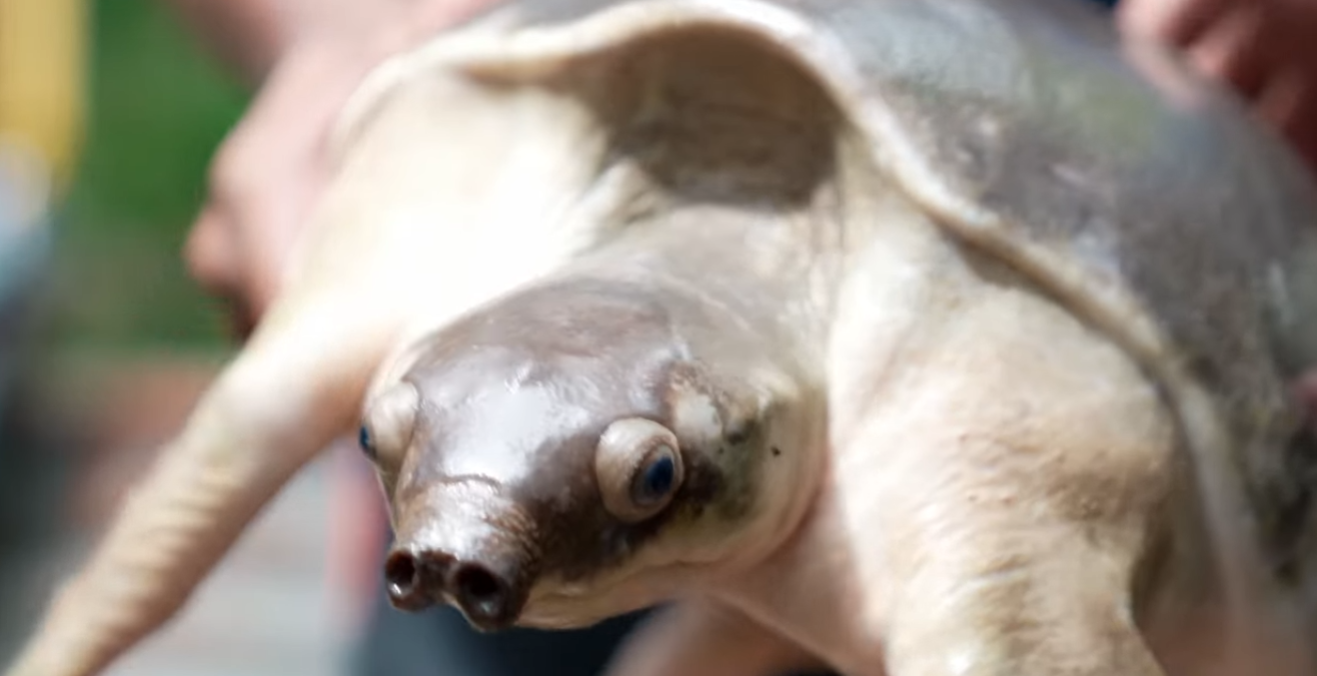
Photo: The pig-nosed turtle and bird-of-paradise are endemic to the Kali Kao region. TSE Group highlights the urgency of preserving their natural habitat through a video documentary.
BOVEN DIGOEL – Amidst Papua’s lush forests and pristine rivers, rare species coexist with nature. Some have yet to receive scientific names, waiting to be studied further by researchers.
In Papua’s waters, one notable species is the pig-nosed turtle (Carettochelys insculpta), a unique reptile believed to have survived for over 100 million years. Meanwhile, up in the tropical forest canopy, the greater bird-of-paradise (Paradisaea apoda) dances with its distinctive golden feathers, serving as a symbol of Papua’s natural beauty.
Both species inhabit the Kali Kao region, a river that is integral to the forest ecosystem and a life source for local communities. For many residents, Kali Kao is more than just a waterway; it is the lifeblood connecting humans, forests, and wildlife that have coexisted for generations.
Through a documentary video, Tunas Sawa Erma (TSE) Group highlights the importance of protecting the habitats of Papua’s endemic wildlife, given their high ecological value. The video portrays Kali Kao as a home to various species, including the river-dwelling pig-nosed turtles and the canopy-inhabiting greater birds-of-paradise.
This documentation also aims to raise public awareness regarding endemic wildlife conservation and the importance of maintaining ecosystem balance in Papua.
The video on Kali Kao is available in three languages to reach a wider audience:
Through this documentary, TSE Group hopes to encourage more people to recognize and care for Papua’s rich biodiversity and understand the importance of preserving natural habitats for future generations. (PR)
Who would have thought that behind its shiny golden feathers and captivating lekking dance, the Greater Bird-of-Paradise (Paradisaea apoda) holds an important secret for the survival of tropical forests? Its ecological role is rarely recognized by many people, yet without this magnificent bird, forest regeneration could be significantly disrupted.
Frugivore: Guardian of Forest Regeneration
Two Greater Bird of Paradise individuals on a bintagur tree branch
The Greater Bird-of-Paradise is known as a frugivorous bird, which means that its main food source is fruit. In its daily life, this bird moves from one tree to another in search of ripe fruit. What may seem like a simple feeding habit plays a major role in the ecosystem. The birds do not only just eat fruit, but it also acts as natural seed dispersers.
Some seeds when bird feeds can fall to the ground, while other seeds that are swallowed will come out again with feces in places that are often far from the parent tree. In this way, Greater Bird-of-Paradise helps new plants grow in various locations, maintaining forest diversity and ensuring that natural regeneration continues.
A Natural Agent of Ecological Succession
When the research team observed its behavior, it was clear that this bird of paradise loved to eat a variety of forest fruits—from nibung, mendarahan, pala (nutmeg), beringin rambat (climbing figs), to jambuan. Uniquely, the seeds from these fruits are not only eaten to fill their stomachs.
Seeds that come out of the bird’s digestive tract often fall far from the parent tree, providing opportunities for new seedlings to grow themselves elsewhere.
A Great Yellow Bird of Paradise eating nibung fruit
Seeds eaten by birds of paradise are often dispersed when these birds jump from one tree canopy to another. As a result, new plants can grow in empty spaces, open areas, or even forests that have been disturbed. Through this simple method, the Greater Bird-of-Paradise contributes to plant diversity and accelerates forest recovery. It is no wonder, it can be considered one of nature’s important agents in the process of ecological succession.
Birds-of-Paradise and Biodiversity
Natural regeneration in Asiki Forest, South Papua
With their ability to travel long distances and move between high forest canopies, the Greater Bird-of-Paradise play an important role in increasing forest biodiversity. Their extensive movements enable the dispersal of seeds from various plant species to different areas, including locations far from the parent trees. Each seed dispersed is like a small puzzle piece of forest life, ensuring a diverse, healthy, and thriving ecosystem.
The role of fruit-eating birds such as the Greater Bird-of-Paradise extends beyond just one or two types of trees. Many tropical forest
plants depend on animals for seed dispersal. Without them, plant diversity would decline, and the structure of the forest could become homogeneous or degraded.
More Than Just a Bird
Protecting Greater Bird-of-Paradise is not just about ensuring that this beautiful bird soaring freely, but also about safeguarding the forest continues to breathe. From the fruits it consumes to the seeds it disperses, the bird helps the forest regenerate and sustain the diversity of life within it. Every effort to conserve the Greater Bird-of-Paradise is, in essence, an effort to protect Papua’s tropical rainforests and all the creatures that depend on them.
The Greater Bird-of-Paradise is not only an icon of Papua’s natural beauty, but also an integral part of the cultural heritage of Indigenous Peoples. Behind efforts to conserve this endemic bird, indigenous communities play an irreplaceable role as forest guardians, habitat protectors, and custodians of ecological values passed down from through generations.
More Than Just a Bird: The Spiritual Meaning of the Bird-of-Paradise
Indigenous Papuan communities play an important role in preserving birds of paradise. With their knowledge inherited over generations, they know when the mating season takes place, which trees are used for lek, and recognize which food tree species must be preserved. Customary laws often prohibit the cutting of certain trees or the hunting of animals, including birds-of-paradise. For some communities, these birds of paradise are even considered sacred, spiritual symbols that must be respected.
For many indigenous Papuan communities, the Greater Yellow Bird-of-Paradise are not just beautiful birds, but also symbols of ancestral spirits. Its graceful movements atop tall trees are seen as a connection between the earth and the sky. Its presence in the forest signifies that humans are still living in harmony with nature and tradition. Conversely, the disappearance of birds-of-paradise from an area is often interpreted as a sign that this balance has been disturbed.
Sacred Forest: A Hidden Stronghold for the Bird-of-Paradise
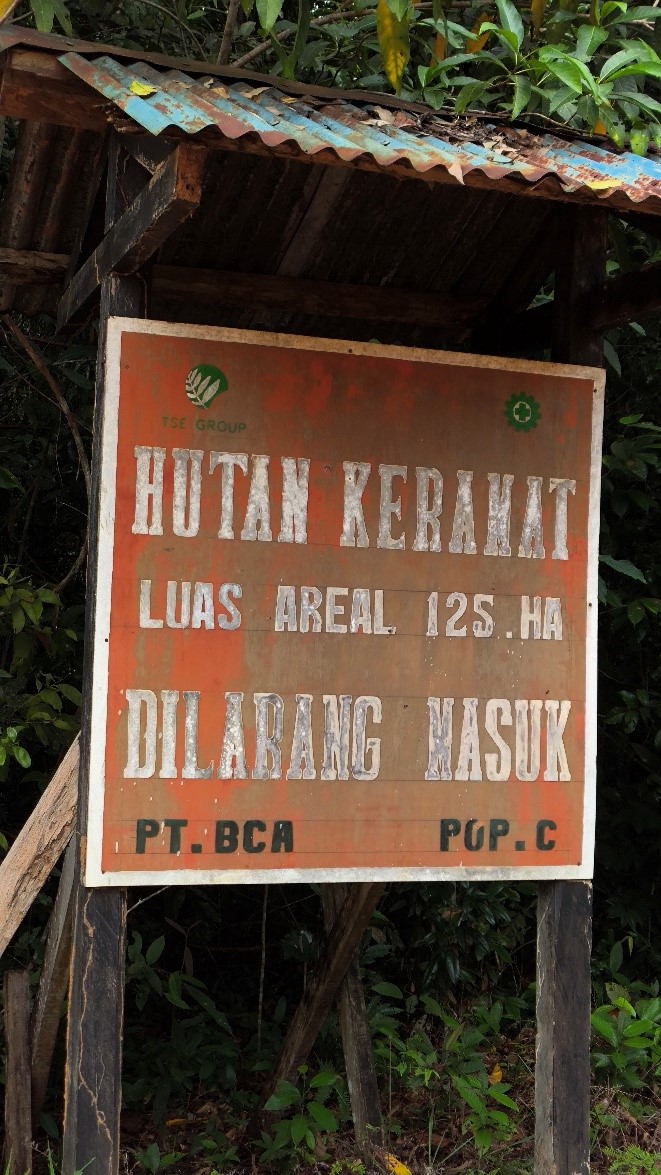
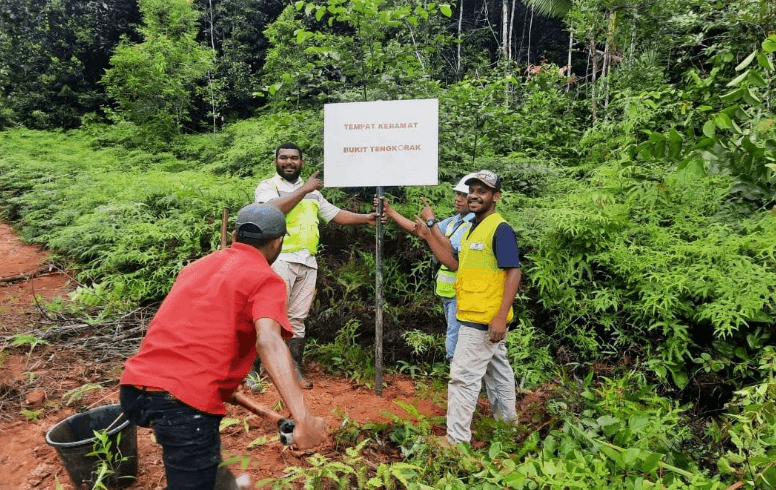
In Papua, certain forests are not only rich in biodiversity but also hold deep spiritual significance for Indigenous communities. One such area is the High Conservation Value (HCV) forest managed by TSE Group, which known locally as a sacred forest. For indigenous communities, this forest is protected by strict customary rules—it must not be cut down cleared indiscriminately or damaged. Without much awareness, these rules have made the sacred forest a natural conservation stronghold.
Within these forests, the Greater Bird-of-Paradise and other iconic species can continue to live safely, perform their mating dancse, and reproduce in their natural habitat.
Because of their sacred status, indigenous communities usually strictly prohibit any form of activity in these sacred forests—from cutting down trees and hunting to entering without permission. These customary rules act as a natural shield, protecting both flora and fauna. In many ways, sacred forests function as informal conservation areas born out of local wisdom.
Interestingly, large trees used by male birds-of-paradise for lekking are frequently found in sacred forests that have remained untouched by human activity. It is therefore not surprising that some of the most active and stable lekking sites are found around these sacred forests.
Sacred Forest as Natural Conservation
Sacred forests demonstrate that conservation is not always about science or formal rules. In many cases, local culture and beliefs serve as the most effective “protectors of nature.” Protecting forests because they are considered sacred has proven to be highly effective in maintaining ecological functions naturally. Local cultural values and beliefs are often respected and upheld more consistently than national laws.
Installation of sacred forest signboards around the TSE Group’s HCV area
Papua’s sacred forests are not only a cultural legacy, but also part of a natural conservation system that has existed for centuries. Respecting, recognizing, and supporting the protection of sacred forests also strengthens the conservation of rare species such as the Greater Yellow Bird-of-Paradise and helps maintain the overall balance of Papua’s ecosystem.
One of the most fascinating aspects about the Greater Bird of Paradise (Paradisaea apoda) is its unique mating ritual. Rather than simply singing or displaying their beautiful feathers, the males perform a “spectacle” known as lekking, a remarkable mating ritual that becomes a contest of charm deep within the Papuan forest.
Lekking is a unique mating strategy, in which males gather at a specific location called a lek site. There, they take turns dancing, fluttering their brightly yellow colored feathers, and making distinctive, repetitive sounds. All of these “performances” serve one simple goal: to attract females and get the chance to become their mate.
An Audition Stage in the Papuan Forest
For the Greater Bird-of-Paradise, lekking functions like an “audition stage” in the heart of the forest. The males compete intensely to dance, spread their golden feathers, and sing loudly to captivate the watching females. Only the most impressive ones will be chosen, while the others must try again the next day. After a brief mating, the female leaves to build her nest and raise her young alone. The male, meanwhile, returns to the lek tree, ready to repeat the performance, a natural cycle that shows how amazingly sexual selection works in the wild.
Performances in the Dry Season
Every morning, before the sun climbs too high, male Greater Bird-of-Paradise will choose the tallest tree around the lek site as their “main stage.” From this elevated perch, the dance, the shimmering decorative feathers, and the distinctive call can be seen and heard more clearly, both by females and rival males. Interestingly, lekking ritual usually takes place during the dry season, between June and October. When the forest is drier and the air is clear, their voices can reach further, making this open-air show even more captivating.
Male Dominance at Peak Lekking Season
Field observations during the lekking season show that male birds are far more dominant. This is likely because observations were made during the peak breeding period, when males are most actively displaying themselves. In the lek trees, males continuously perform their signature dances, fluttering their yellow-colored decorative feathers, and singing loudly to attract the attention of females and ward off competitors. Occasionally, several females are seen coming to the lek site, observing carefully and assessing which males are the most suitable to choose.
The Ritual of Preparing the Lek Arena
During the lek season, research found eight lek trees actively used by Greater Bird-of-Paradise. Beneath these trees, many scattered branches and leaves were found. This is no coincidence, apparently, the male birds deliberately “tidy up” their stage by cleaning debris from the forest floor. This allows their decorative feathers to be clearly visible when they dance under the natural light of the forest. This finding is in line with research by Stein and Uy (2006), which states that lekking birds often maintain their performance arena in order to appear more attractive to females.
Lekking, Forests, and the Future of Birds-of-Paradise
The lekking behavior of the Greater Bird-of-Paradise demonstrates the close relationship between beauty, reproduction, and habitat conservation. This complex mating ritual can only take place in intact forests, with tall trees serving as their natural stage. Preserving the forests of Papua means protecting the birds’ habitat while ensuring that one of nature’s most spectacular shows continues for future generations.
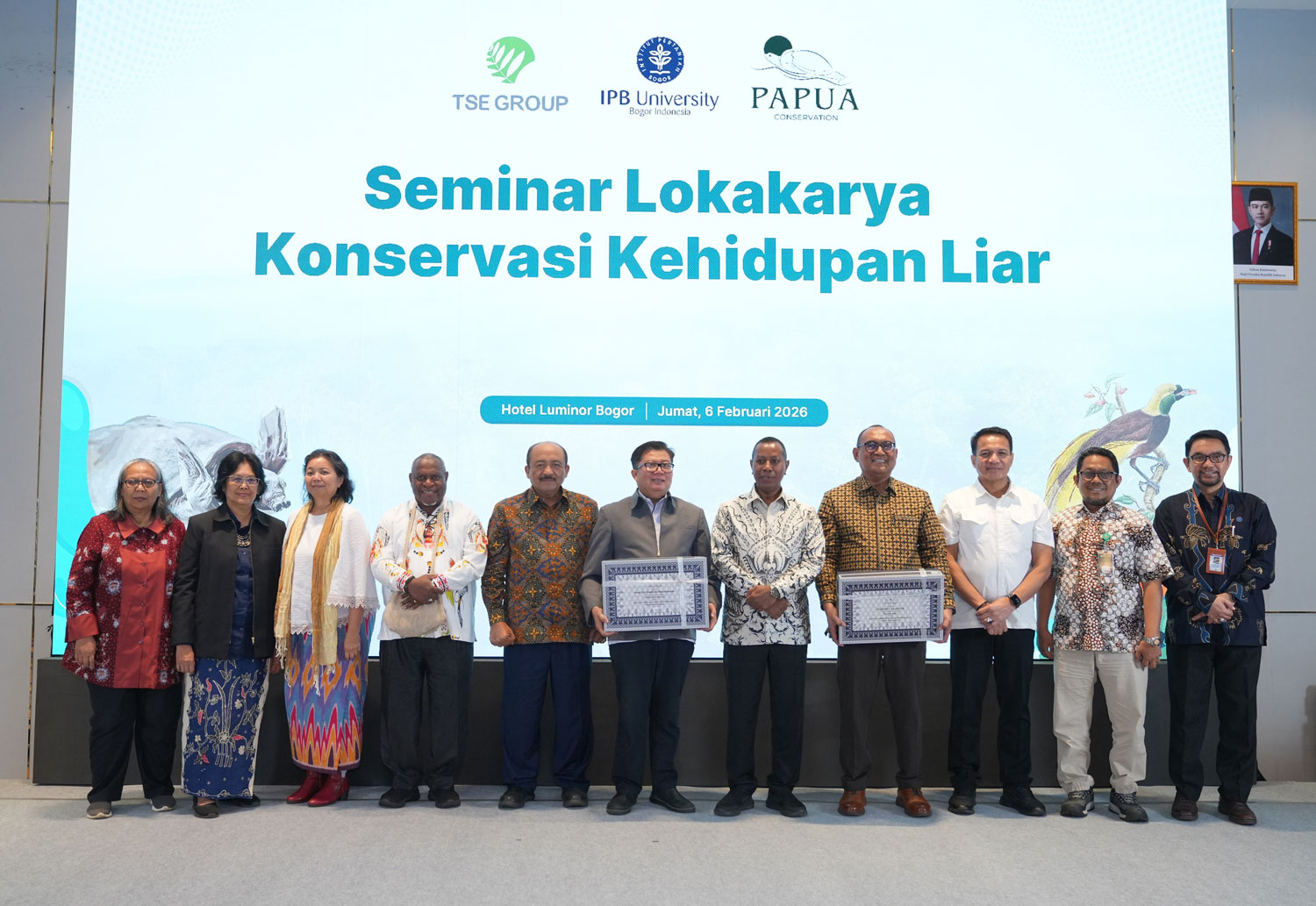
This event is attended by IPB University’s bird-of-paradise and pig-nosed turtle research teams, South Papuan Governor Apolo Safanpo, South Papua’s Papua’s People Assembly Chairman Damianus Katayu, National Research and Innovation Agency (BRIN) officials, management authorities, academicians, and Indonesian Palm Oil Association members
BOGOR — Despite climate changes, the responsible management of production forests and riverscapes continues to help protect pig-nosed turtle and greater bird-of-paradise homes in Papua, said a four-year joint research between IPB University and Tunas Sawa Erma (TSE) Group.
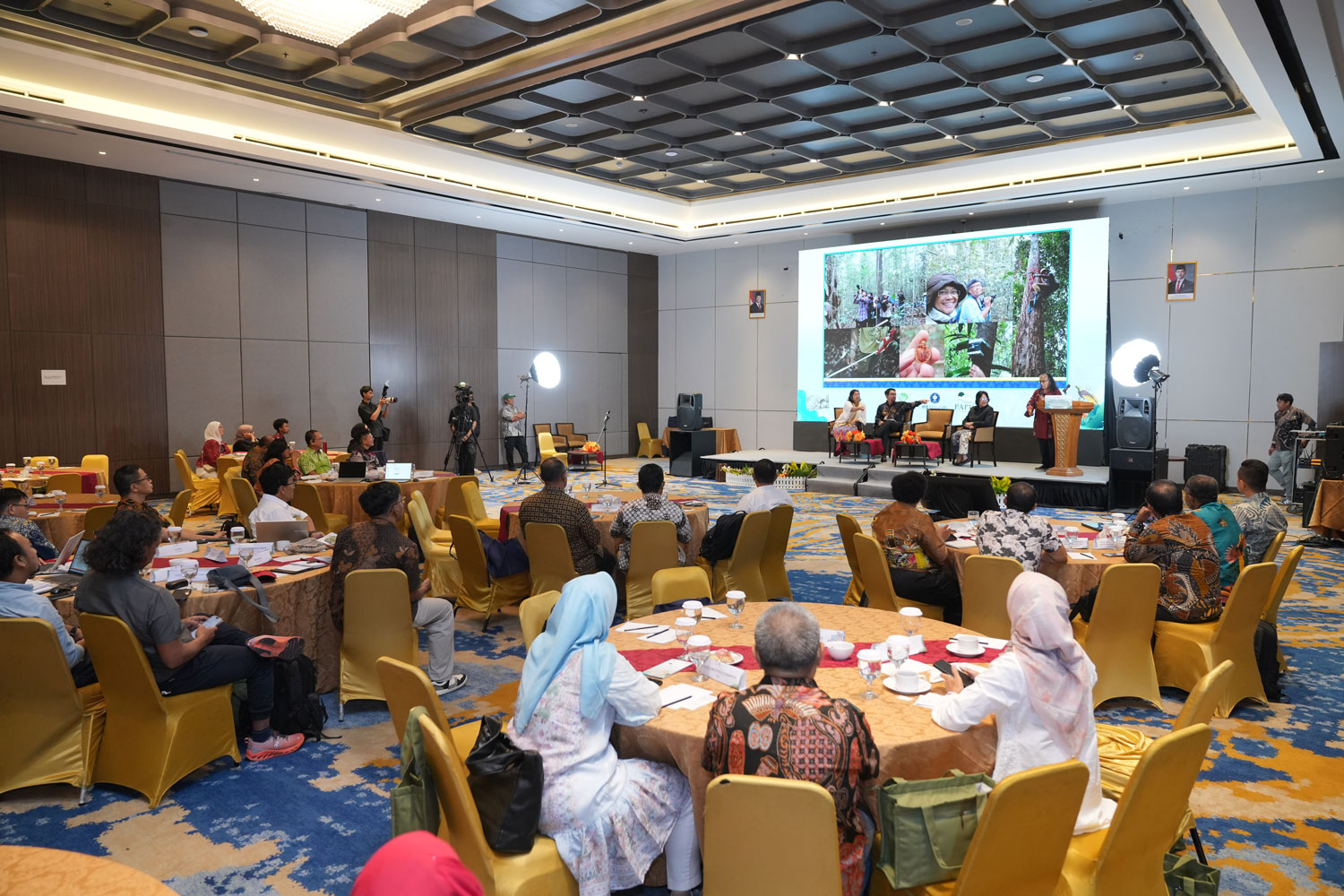
This finding was made public at “Melindungi Ikon Papua: Pemantauan Jangka Panjang Kura-kura Moncong Babi dan Cenderawasih” (Preserving Papua’s Icons: Long-Term Observation of Pig-Nosed Turtles and Birds-of-Paradise), a wildlife conservation seminar and workshop held Friday (2/6/2026) in Bogor. The event was part of a long research project conducted by IPB University and TSE Group since 2022.
Another point highlighted consistent occurrences of greater birds-of-paradise (Paradisaea apoda) within TSE Group’s production forests, where selective harvesting is practiced. Throughout the study, over 100 birds were identified across two forest concessions, with half of the area showing high levels of habitat suitability.
Authors have also found success in documenting lekking (mating) events, and recognizing lek and food-producing trees that are key to the species’ longevity.
Prof. Ani Mardiastuti — in charge of the greater birds-of-paradise research — said forest management practices that maintain high conservation value (HCV) areas and employ selective harvesting contribute to endemic bird preservation in Papua.
“Responsibly-managed production forests remain capable of supporting the lives of birds-of-paradise, and even hold potential for birding ecotourism.”
Meanwhile, on the freshwater front, a close examination of the pig-nosed turtles revealed climate change as an increasingly defining factor for the species’ breeding success.
Extreme precipitation and flooding on the Kao River have caused spawning failure in multiple observation sessions, underscoring the need for conservation strategies that rely both on habitat safeguarding and climate adaptation.
Pig-nosed turtle researcher, Prof. Mirza D. Kusrini, emphasized the importance of long-term monitoring in studying the effects of weather anomalies on animal life cycles.
Prof. Mirza D. Kusrini, Prof. Ani Mardiastuti, and Dr. Yeni A. Mulyani speaking on pig-nosed turtle, greater bird-of-paradise, and herpetofauna research conducted by IPB University’s Forestry and Environment Faculty and TSE Group
“Prolonged observations are crucial for understanding weather anomaly impacts on breeding success. By working with locals, we can ensure conservation efforts continue unabated.”
From a business perspective, this research establishes stronger foundations for accountable forest management practices. TSE Group’s Director Wicklief F. Leunufna affirmed local environmental and wildlife preservation as part of the company’s commitments.
“Through our research collaboration with IPB University, we aim to continuously align our operations with evidence-based conservation.”
This seminar slash workshop featured a cross-sectoral discussion forum that identified opportunities and obstacles to long-term observation. The segment also suggested science-based policy and technical recommendations for protected wildlife management in Papua.
IPB University’s Forestry and Environment Faculty Dean, Prof. Dodik Ridho Nurrochmat, hoped to see their study being referenced in future regional policymaking.
The seminar is part of IPB University and TSE Group’s accountability reporting in regard to this long research project
“We hope this forum becomes a platform for knowledge exchange, as well as stakeholder input and mandate to keep our research aligned with needs for actionable policies.”
South Papuan Governor Apolo Safanpo, also in attendance, said data-driven research is central to public policy decisions. Credible studies ensure development decisions and natural resource management are carried out with respect to the people and planet, he added.
Altogether, IPB University and TSE Group’s joint project covers wildlife population monitoring, HCV area protection, and technical recommendation development for managing key species. Its results are expected to serve as a valuable reference for local governments, businesses, and other stakeholders in strengthening wildlife and broader ecosystem conservation in Papua, especially in the face of climate change pressures. (*)
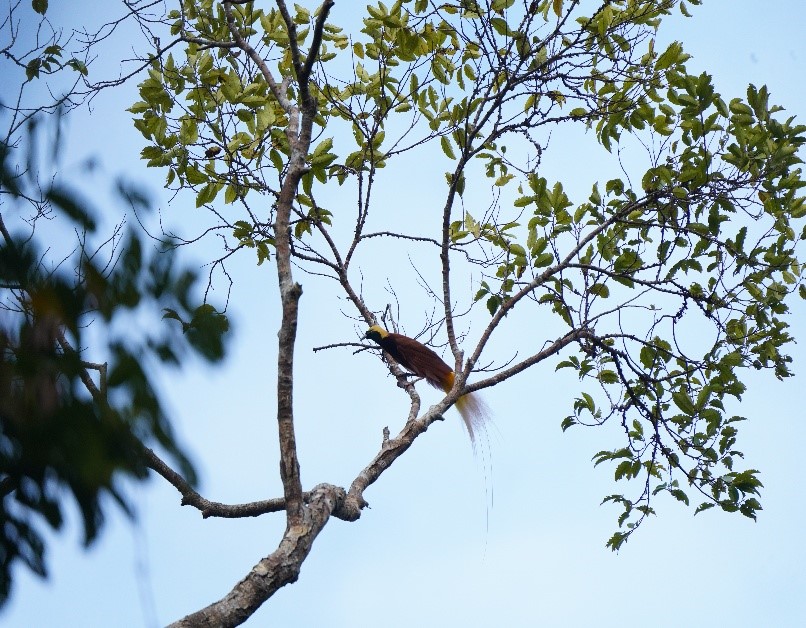
The observed birds of paradise perched on tree branches
The Greater Bird-of-Paradise is well known for its beautiful plumage and mesmerizing mating dance. However, behind this beauty lies a serious threat. For this species, beauty can become a curse. Its population is increasingly pressured by three main threats: poaching, habitation loss, and the impacts of climate change. If these challenges are not addressed immediately, this iconic bird of Papua could lose its natural habitat.
Poaching: The Threat behind the Beauty of Bird-of-Paradise
One of the greatest threats to the great golden bird-of-paradise is illegal hunting. The male’s golden feathers make it a prime target, despite the species is legally protected under Indonesian law. Unfortunately, poaching still occurs in several parts of Papua, especially during the mating season between May and August.
According to BirdLife International (2016), the Greater Bird-of-Paradise is still classified as Least Concern on the IUCN Red List. While this status may appear reassuring, populations in the wild continue to decline due to hunting pressure. This decline could have serious consequences, as male birds play an important role in lekking—a mating display that determines whether or not a new generation will be born.
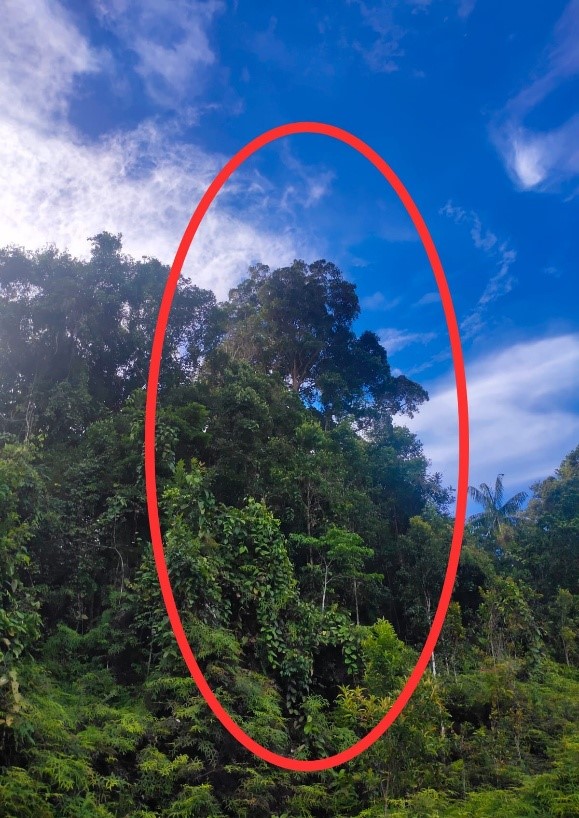
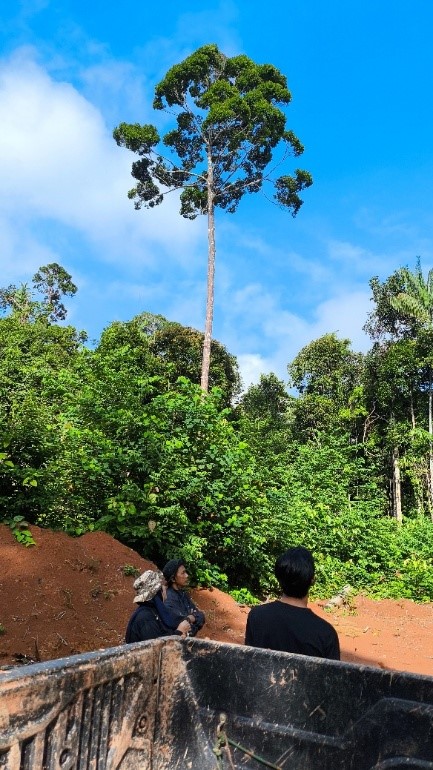
The remaining emergent trees became lekking sites
Shrinking Habitat Destroyed, a Dance under Threat
In addition to hunting, habitat loss poses another serious threat to the Greater Bird-of-Paradise. Papua’s primary forests are steadily shrinking due to development and land-use conversion. The tall trees that were once served as main stages for mating dances are now increasingly scarce, causing these birds of paradise to lose their best breeding grounds.
The consequences extend beyond disrupted mating rituals. Forest fragmentation separates populations, increasing the risk of reduced genetic diversity. Moreover, reduced forest cover means fewer food trees to support the life of these birds of paradise, further threatening its survival.
The Silent Threat of Climate Change
Climate change presents a less visible but equally significant threat. Shifts in the rainy and dry seasons have disrupted their mating schedule. As a result, the breeding season often no longer coincides with the abundance of food, making it difficult for chicks to find food.
Rising temperatures, unpredictable rainfall, and more frequent storms alter are also reshaping Papua’s forests ecosystems. If this continues, the birds may lose not only their dancing grounds, but also their long-term future in the wild.
Collective Action for Forests and Birds-of-Paradise
Protecting the Greater Bird-of-Paradise requires more than regulations on paper. The key lies in the involvement of many parties—from local communities to forest managers. Conservation education, bird-based ecotourism initiatives, and continues field research to monitor populations must all work together. Preserving the trees where these birds perform their courtship dances means safeguarding Papua’s forests and the life within them. As long as the birds-of-paradise continue to dance among the treetops, the balance of nature remains intact.
The Great Bird of Paradise (Paradisaea apoda) captivates not only with its stunning plumage but also through its enchanting and unique courtship ritual. In Papua’s tropical forests, the males perform spectacular lek dances—more than just a biological process, these displays are a “natural performance” that showcase the wonders of evolution and the power of sexual selection.
A Majestic Dance in the Dry Season
From June and October, during the dry season, lekking activity among Greater Birds-of-Paradise reaches its peak. Every morning before the sun shines brightly, the males choose the tallest trees as their “performance stage.” There, they perform with distinctive movements, spreading and fluttering their long, golden plumes in a dazzling display. Along with their dance, the males call out in loud, distinctive songs that echo through the forest – drawing females while asserting dominance to rival males. Fascinatingly, several males gather at a single lekkking area, turning the forest into a grand arena of competition.
The Female, the True Judge in the Lekking Arena
Female greater birds-of-paradise are highly selective in choosing their mates. They do not simply accept every male that shows off at the lek site. From a distance, the female carefully observes each male’s dance, posture, and shimmering plumage – just like a judge evaluating “best performance.” This courtship can take time, stretching over days or even weeks. Only males with the most captivating dance, well-proportioned bodies, and immaculate, shining feathers stand a chance of being chosen.
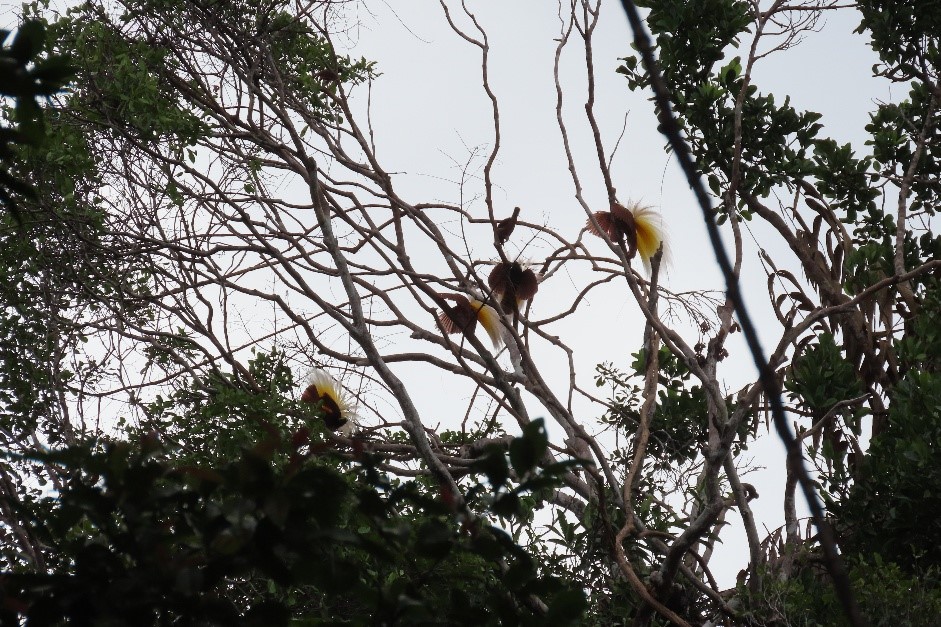
Four male great greater birds-of-paradise perch together, each performing their signature dance to attract a mate.
Once she is captivated, the female approaches with calm movements or gives a soft call as a signal of acceptance. Mating is brief, taking place only once in a single encounter. Soon after, the female departs to build her nest and raise the young birds entirely on her own—a striking portrait of independence.
The Fierce Competition in the Lekking Arena
Interestingly, in a single mating season, only a few males actually succeed in finding a mate, while most return home empty-handed. This shows just how intense the competition is in the lekking arena—only males with the finest appearance and the most captivating dances win the female’s heart. The unsuccessful males, however, do not give up. They return to try again in the next season, or even move to another lekking area to seek new opportunities.
A Clever Reproductive Strategy of the Greater Bird-of-Paradise
Research by IPB and TSE Group in 2022 revealed a unique pattern in the mating behavior of the Greater Bird-of-Paradise. Instead of coinciding with the peak of the fruit season, mating actually occurs earlier. This strategy is remarkably clever: by the time the chicks hatch and need abundant food, the fruit trees are already bearing heavily. This natural synchronization ensures the young birds receive sufficient nourishment from the very beginning of their lives, while also illustrating how evolution has shaped a delicate balance between animal behavior and the availability of natural resources.
The Greater Bird of Paradise captured on camera in the Asiki Forest, South Papua.
The Greater Bird of Paradise (Paradisaea apoda), is one of Papua’s most iconic treasures. With its dazzling plumage and mesmerizing mating dance, it has earned the nickname “the bird of paradise.” But this species is not only visually attractive, it also plays an important role in the forest ecosystem. What makes it even more fascinating is that the Greater Bird of Paradise exists naturally only in the southern forests of Papua and the surrounding islands.
What secrets make the forests of Papua the only natural home for this magnificent bird? Let’s take a closer look at what makes its habitat so unique.
Humid and Stable Tropical Rainforests
The Greater Bird of Paradise makes its home in the lowland tropical rainforests of Papua. These evergreen forests, stay warm and humid almost all year round, with rainfall ranging from 2,500 to over 5,000 millimeters annually. It’s a landscape that never really dries out – a perfect paradise where they can feed on fruits, perch high on brances, and perform their dazzling mating dances.
The Asiki Forest, in particular, is like a dream home for the Greater Bird of Paradise. Temperatures stay pleasantly at around 25–26°C throughout the year. In addition, it rains throughout the year in this region—with an average of 3,395 mm per year. The high humidity keeps the forest feel cool and moist, providing ideal conditions for plants to thrive and produce the fruits these birds depend on.
This unique mix of steady climate, abundant rainfall, and high humidity creates a truly supportive ecosystem which perfectly in balance. For the Great Bird of paradise, such stability is crucial, especially since their iconic lekking dance displays rely on the delicate harmony of their forest habitat.
Dense Forest Canopy Cover
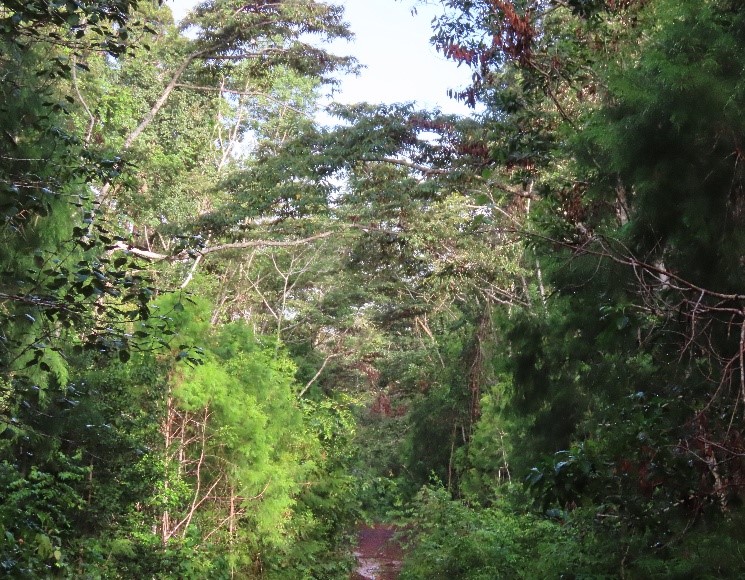
For the Greater Bird of Paradise, the forest is both a home and a stage. Its dense, towering canopy offers everything they need – from resting perches and safe nesting spots to a lush green arena for shelter. High among the branches, the males perform their energetic dances, flaunting their shimmering golden feathers to captivate the females.
Research in the Asiki Forest shows that the Great Bird of Paradise’s habitat has an average canopy height of 24.5 meters. Imagine the forest as a multi-story building with four main layers: upper canopy, middle canopy, shrub layer, and ground cover. The tree density here is also remarkably high, exceeding 70%. Together, these conditions create a shady and humid environment, an ideal habitat that sustains the life of The Greater Bird of Paradise.
Far from Human Activity
A lekking tree located far from human activity
The Greater Bird of Paradise are extremely sensitive to disturbances—even the sound of footsteps or a soft conversation can cause them stop dancing. Quiet, undisturbed spaces in the Papua’s forests are essential for their survival. Spatial analysis shows that their habitats are, on average, located quite far from human activity: about 2.2 km from road networks, 2 km from oil palm plantations, and 800 meters from developed land. This confirms the fact that the farther they are from human activity, the greater their chance of survival.
Fortunately, most of Papua’s forests remain protected and far from development. These untouched areas serve as the main stage for birds to dance, forage, and breed without interference. The lush, silent forests provide a safe haven for them to perform their spectacular lekking dances and continue their life cycle. Conservation efforts through careful area management are crucial to ensuring that these birds can keep dancing freely in Papua’s forests.
Papua’s forests are among the most biodiverse on Earth, and home to one of the most mesmerizing bird species—the Great Yellow Bird-of-Paradise (Paradisaea apoda). Part of the famed Paradiseaeidae family, this bird is known worldwide for its beauty.
Beauty that puts it at Risk
With shimmering yellow-golden feathers that shine when exposed to sunlight, the Great Yellow Bird-of-Paradise looks almost ethereal, making it look like a creature from another world. No wonder it has earned the nickname “the dancer of paradise.” Endemic to Papua, it is a living treasure found nowhere else on the planet.
But this beauty has come at a cost. For centuries, its feathers have been hunted for ornaments and illegal trade. Deforestation further threatens its survival, shrinking the forests it depends on. Losing this bird would mean more than the loss of one species, as it disrupts the balance of the entire ecosystem.
A Closer Look
Since 2022, researchers from IPB University and TSE Group have been studying the Great Yellow Bird-of-Paradise. Their work has included mapping habitats, counting populations, and documenting the species’ unique courtship ritual—the lekking dance.
What the Research Found
The findings have been both fascinating and hopeful. In the concession forest managed by PT Inocin Abadi, 27 individuals were recorded—10 males with striking plumage and 17 females who faithfully watched their dances. Meanwhile, in the PT Tunas Timber Lestari area, 15 females were documented.
Syzygium sp. Tree as the Lek Site of the Greater Bird-of-paradise
Researchers also found several lek trees—special tall trees where males perform their “dance show” to attract females. In PT Inocin Abadi’s concession area, two lek trees were found, while in PT Tunas Timber Lestari’s area there were six lek trees. These trees are not just any trees, they are often jambuan, matoa, kelat, or medang which are not necessarily the thickest (around 33–70 cm), but they tower above the other trees, surrounding canopy, making them the perfect stage.
From this height, male birds can more easily spread their golden wings, display their dances, and call loudly to attract mates with loud voices. The lek season usually runs from July to September, peaking in August. During this time, the forests transforms into a breathtaking natural stage. The males dance, jump, and flap their golden wings, while the females carefully select the best mates. Papua’s forest theater at its finest.
A Sign of a HealthyForest
If birds of paradise are still dancing in an area, it means that the forest is alive and thriving. Tall trees remain standing, the food chain stays intact, and the forest’s microclimate holds steady. Their disappearance, on the other hand, is a sign of greater damage to ecological breakdown.
Safeguarding the Great Yellow Bird-of-Paradise means preserving Papua’s forest as a whole. The tall trees where they dance, the wildlife that shares the habitat, and the very soil they all depend on are deeply interconnected. Conservation efforts cannot stand alone, it requires seeing the forest as a living entity.
Through collaboration—combining science, conservation, and local communities—this iconic bird can continue its golden dances high above the Papuan canopy. More than just a “wonder of nature”, it is a symbol of hope for forest conservation and future generations.
National palm oil company Tunas Sawa Erma (TSE) Group is building a research vessel called Papua Lestari. Photo: TSE doc.
Papua: Indonesia palm oil company Tunas Sawa Erma (TSE) Group is building a research vessel called “Papua Lestari” to find out about the life of the pig-nosed turtle and the river ecosystem of its habitat in South Papua.
The vessel can accommodate five people to do activities inside. The vessel not only provides space for research equipment but also equips researchers with various facilities to simplify their work.
This vessel is an important facility to conduct research on aquatic biota in Papua, especially the pig-nosed turtle. We hope that “Papua Lestari” will enhance the quality of research by enabling researchers to carry out their activities more effectively.
The research vessel “Papua Lestari” is actually a facility provided by the TSE Group, not only as a means of transportation for researchers but also as a symbol to spread the message of conservation.
Environmental conservation
“We built Papua Lestari to research the ecosystem in rivers and swamps in Papua, including pig-nosed turtles, fish, snakes, and so on.” In addition, this research vessel can also be a symbol to open people’s eyes to the importance of environmental conservation,” said TSE Group Director Luwy Leunufna in a written statement, Tuesday, April 29, 2025.
The completion of this ship is part of the Papua Conservation Program commitment launched by TSE Group and IPB University in 2022. This programme aims to protect the right to life and increase public awareness of endemic animals.
This programme not only focuses on conservation for pig-nosed turtles but also other endemic Papuan animals, namely the large yellow bird of paradise in Merauke and Boven Digoel Regencies, South Papua.





 Male Dominance at Peak Lekking Season


 Interestingly, in a single mating season, only a few males actually succeed in finding a mate, while most return home empty-handed. This shows just how intense the competition is in the lekking arena—only males with the finest appearance and the most captivating dances win the female’s heart. The unsuccessful males, however, do not give up. They return to try again in the next season, or even move to another lekking area to seek new opportunities.

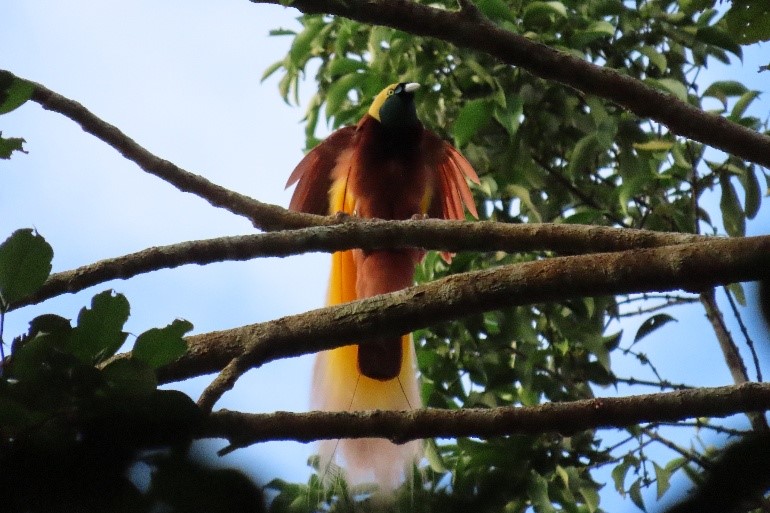

 For the Greater Bird of Paradise, the forest is both a home and a stage. Its dense, towering canopy offers everything they need – from resting perches and safe nesting spots to a lush green arena for shelter. High among the branches, the males perform their energetic dances, flaunting their shimmering golden feathers to captivate the females.