
The pig-nosed turtle (Carettochelys insculpta) is one of the most unique freshwater animals in the world. Found only in Papua (Indonesia), Papua New Guinea, and northern Australia, this reptile is the sole surviving member of the Carettochelyidae family, making it a “living fossil” that tells the story of evolution from millions of years ago. Beyond its distinctive physical appearance, the pig-nosed turtle exhibits a number of unique behaviors that set it apart from other freshwater turtles.
A True Amphibian with a Distinctive Life Cycle
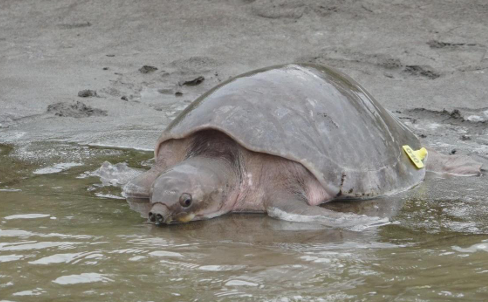
A mother pig-nosed turtle coming ashore to lay eggs
Although classified as a freshwater turtle, the pig-nosed turtle almost never leave its natural habitats in rivers, lakes, or swamps. It is truly a fully aquatic species. The only time it comes ashore is when the female lays her eggs. During nesting season, the female digs a hole in sandy riverbanks then lays her eggs there before returning immediately to the water, leaving the nest unattended. Interestingly, this simple process has a significant impact on the ecosystem, as it indirectly helps transfer nutrients from the water to the land.
A Sea Turtle-Like Swimming Style
 Unlike most freshwater turtles, which have only webbed feet, pig-nosed turtles actually have flipper-like limbs similar to those of sea turtles. This unique adaptation makes it extremely agile in the water. Using a movement often referred to as “underwater flight,” it propel itself by alternating or synchronizing it front flippers, while the hind flippers act as rudders. This body design makes it a formidable swimmer capable of navigating fast-moving river currents, while also giving them an advantage when hunting for food or evading predators.
The Ability to Stay Underwater for Hours
 One of the pig-nosed turtle’s most remarkable adaptations is the way it breathes. In addition to using lungs like other reptiles, it can also absorb oxygen through its cloaca—an opening near the tail. Inside are specialized, highly vascularized sacs known as cloacal bursae, which enable oxygen directly from the water. Thanks to this trick, pig-nosed turtles can stay underwater for hours without surfacing frequently. This is particularly helpful in murky waters or when resting peacefully while remaining safe from predators.
The Snout as a Sensory Tool
 The pig-nosed turtle’s most iconic feature is its snout—long, flexible, and pig-like, with highly sensitive nostrils. This specialized structure functions almost like an underwater sensor, capable of detecting vibrations and scents even in murky rivers. With this ability, the turtle can sniff out prey such as small fish, mollusks, shrimp, or even fruit that has fallen from the forest into the water. Its flexible snout is also essential for squeezing into narrow gaps between rocks and roots, makes it an expert hunter in their habitat.
A Proof of Remarkable Adaptability
The unique behavior of the pig-nosed turtle not only reflects its remarkable adaptation to freshwater environments but also highlights its vulnerability. Habitat degradation, declining water quality, and illegal hunting pose increasing threats to its survival. Protecting the pig-nosed means more than conserving a single species, it also helps preserve the balance of the river ecosystem, which serves as a home for many other forms of life. This species is not only a rare endemic treasure of Papua but also a powerful reminder of the importance of conserving biodiversity for future generations.
