
The Economic Costs of Pig-Nosed Turtle Trade in Papua
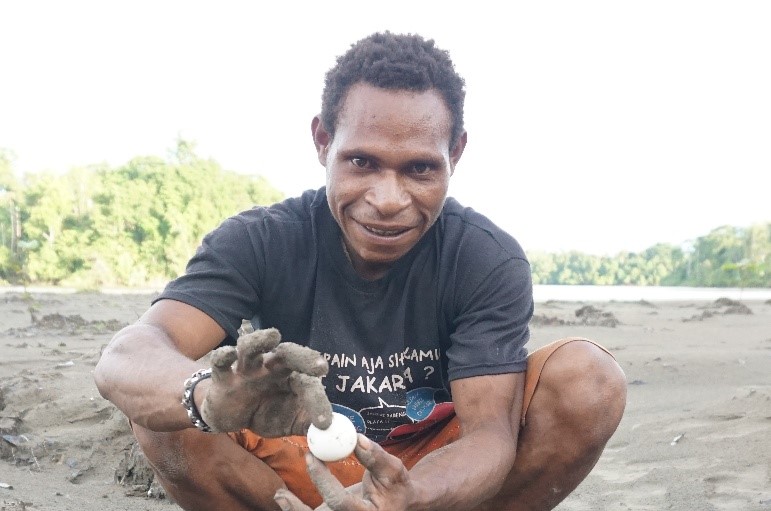
BOVEN DIGOEL — For many hunters in Papua, searching for the eggs of the pig-nose turtle (Carettochelys insculpta) is not merely a matter of wildlife hunting. This activity has been passed down through generations, becoming a way of life and even serving as an economic pillar for their families.
However, the economic returns from this egg harvest do not come without cost. Hunters must grapple with high expenses for boat fuel, unpredictable weather, and fluctuating market prices for hatchlings.
To locate pig-nose turtle eggs, these hunters must prepare substantial capital, as every journey relies heavily on motorized boats and fuel. A single trip can consume between IDR 200,000 and IDR 1,000,000, while total expenses throughout a single season can reach IDR 5,000,000 to IDR 25,000,000.
Frequently, hunters rely on capital loans from middlemen to provide fiber boats and fuel. In return, the entire harvest must be surrendered to the middleman at predetermined prices, with payments calculated based on the number of successfully hatched hatchlings.
In the field, harvest yields are strictly determined by chance and environmental conditions. Out of 97 monitored sandbanks, sometimes only 6 are actually utilized by turtles for nesting. The remainder may lie vacant, be submerged by floods, or be destroyed by predators.
On a separate occasion, during a five-end observation period, 67 nests containing a total of 715 eggs were identified. The clutch sizes varied, with some nests containing 24 eggs and others as few as 4. Some had even been depleted beforehand due to predation by monitor lizards, foraging, or destruction by high tides.
Large Harvest, Abundant Hatchlings
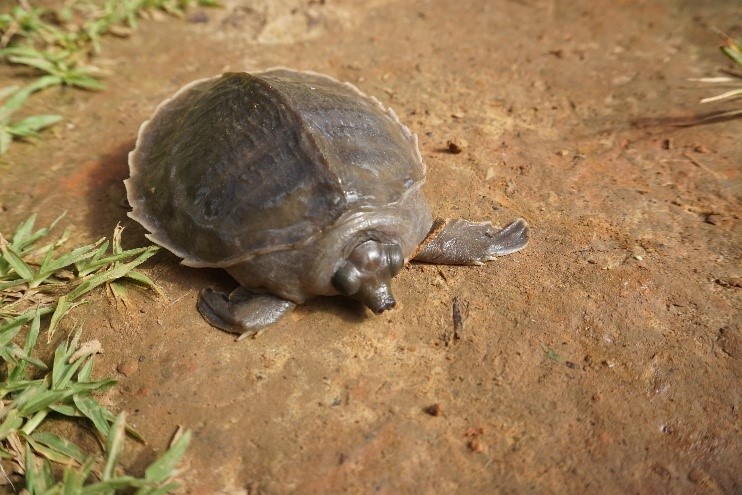
Photo: The pig-nose turtle (Carettochelys insculpta), an endemic animal native to Papua.
One hunter recounted that during the three-month harvesting season, spanning from late August to October, he successfully harvested pig-nose turtle eggs three times, totaling approximately 3,700 eggs. Specifically, the first harvest yielded 1,600 eggs, the second 1,200, and the final one 900 eggs. He noted that natural hatching success rates reached an impressive 85% to 90%, which is remarkably high for natural standards.
If this yield is extrapolated as the harvest for a single clan (marga), the scale becomes significantly larger. Assuming an average of 3,000 eggs per clan across 23 clans within the research location, the total harvest could surpass 69,000 eggs in a single season—an exceptionally large volume for a species with a restricted distribution.
Hatchlings are typically sold between December and January. Prior to the pandemic, market prices were quite lucrative, ranging from IDR 55,000 to IDR 70,000 per individual. However, when the pandemic struck, the market stagnated, and prices plummeted drastically to a range of IDR 10,000 to IDR 15,000. Consequently, during 2020–2021, harvesting and sales activities virtually ceased due to minimal demand, while operational costs far outweighed the revenues.
This condition was vividly observed when researchers arrived in Sesnukt Village, where a resident still kept approximately 50 hatchlings from the 2021 hatching season in a small backyard pond because they could not be sold. Such price fluctuations are not a novel phenomenon.
Data from TRAFFIC in 2010 recorded hatchling prices in Papua at approximately IDR 30,000 to IDR 35,000 per individual. This underscores a strong reliance on market dynamics; if market prices drop, hunters inevitably suffer financial losses as sales fail to cover their substantial harvesting costs.
While harvesting turtle eggs provides tangible income for many families, it carries a heavy ecological cost. Every egg harvested reduces the number of hatchlings returning to the river, and if adult females are captured as well, the species’ regeneration is further imperiled.
Therefore, forward-looking strategic interventions are imperative. These include stricter harvesting regulations, sustainable breeding programs, educational campaigns to ensure a proportion of eggs remains undisturbed for natural hatching, and the establishment of alternative livelihood sources for local communities. Through these measures, pig-nose turtle eggs will not merely serve as “seasonal gold” for the local economy, but will also remain an integral component of Papua’s biodiversity that must be preserved collaboratively. (ESG)
